

Many digital twin research solutions risk becoming the research industry's version of fool’s gold. They shine brightly, delivering rapid answers at scale and creating the impression of deep intelligence. But unless those twins are built on rich data, rigorously validated against real-world outcomes and capable of capturing the complexity of human decision-making, they are more likely to produce false stories than trustworthy insights.
With only 51% of marketers confident that they are getting the right intelligence out of data (Kantar Media Reactions 2026), outputs need to be reliable, decision-grade, and based on high-quality data.
What matters isn't whether a twin looks human - it's whether it predicts human behavior accurately.
So what is a digital twin? It’s a replica of a real-life human research respondent. Using advanced data science techniques, we can build a knowledge graph from their research responses, and infer more information from them using predictive models. So in a way, they are consumer twins.
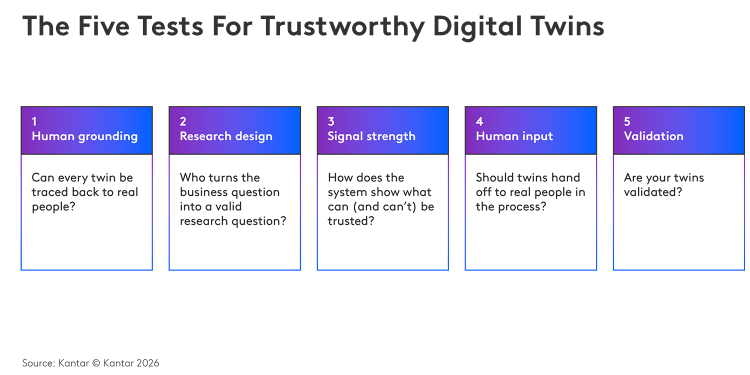
CMOs and their teams need to strike the right balance between excitement and caution, and ask themselves whether twins pass these five tests:
- Human grounding: can every twin be traced back to real people?
- Research design: who turns the business question into a valid research question?
- Signal strength: how does the system show what can (and can’t) be trusted?
- Human input: should twins hand off to real people in the process?
- Validation: are your twins validated?
A consumer twin is only as valuable as the evidence, expertise and escalation system behind it. You could see twins as an accelerant, a new form of interrogation at scale – going deeper into the behaviors, attitudes and expressions we speak about in our Three Signals paper.
Our five tests below come from more than a decade of predicting and validating consumer response with AI, and from the past year building and validating our emerging consumer twins proposition.
1. Human grounding: can every twin be traced back to real people?
Every twin should trace back to real human data, built on years of detailed information about who they are, how they think, what they choose, and what they value. Twins need to be continuously validated against the humans they're based on. If they are acting as a replica of a real person, you need to be sure of the foundational data.
CMOs also need to think about the embedded proprietary capabilities, rather than just the underlying LLM.
Unique datasets contribute value, but what’s also needed is specialized knowledge and IP encoded in models, frameworks, and methodologies that CMOs use to derive intelligence. These allow marketers to derive meaningful and comparable insights from data, rather than merely exposing data to a generic LLM.
And consumer twins aren’t always the answer. For example, when developing and optimizing innovation concepts, we would recommend using our upcoming consumer twins alongside our EvaluateExplorer tool to generate the concepts, before validating them against our database or with real humans. The same would be true for creative shaping: we would embed the IP for LINK AI into the workflow, rather than using consumer twins on their own.
2. Research design: who turns the business question into a valid research question?
A natural-language question is not the same thing as a research question. Translating one into the other is where decades of research expertise come into play.
When someone asks a question, experienced researchers instinctively make a series of judgements. What is the real decision they are trying to make? Who should be asked? Is there enough relevant evidence available? Can the question actually be answered with confidence? These are exactly the same challenges that exist in a consumer twin environment.
Reliable consumer twin systems therefore require far more than a large language model generating answers. They need structured workflows, decision rules and research disciplines that mirror the rigor of traditional insight generation. In many ways, engaging consumer twins should be treated with the same care as fielding real people. The system must determine who to "ask", whether sufficient and relevant data exists to support an inference, whether the question is feasible to answer, and how much confidence can be placed in the result.
A twin ecosystem is not a chatbot. It is a network of interconnected components working together to replicate the judgement calls that researchers make every day.
What do CMOs need? The ability to convert business questions into valid research tasks
3. Signal strength: how does the system show what can (and can’t) be trusted?
One of the biggest risks in today's consumer twin market is treating generated answers as facts simply because they sound plausible.
Traditional research has never worked that way. Weighting, significance testing, validation frameworks and proprietary methodologies exist for a reason: they help distinguish genuine insight from noise.
Consumer twins need an equivalent safeguard. Every answer should be accompanied by an assessment of signal strength, giving users a clear indication of how much confidence they should place in the result. Some answers may be decision-ready. Others may be useful only as inspiration. Some may not be reliable enough to use at all.
This is where robust consumer twin solutions will differentiate themselves. They will incorporate signal strength mechanisms that assess reliability across multiple dimensions, including proprietary IP, data quality and consistency. High confidence answers can be acted on directly. Lower confidence answers should trigger additional research, ensuring that consumer twins complement rigorous insight generation rather than becoming a source of fool's gold.
What do CMOs need? Guidance on whether an answer is suitable for action, exploration or further research
4. Human input: should twins hand off to real people in the process?
One of the biggest misconceptions about consumer twins is that human research becomes less important. In reality, the opposite is true.
Human respondents are not a fallback – they are a fundamental part of the system. When confidence is high, twins can provide answers instantly. When confidence is weak, organizations need the ability to consult real consumers rapidly and at scale. The strongest twin platforms will make that transition seamless, moving effortlessly between synthetic and human insight generation.
Human input is also what keeps the twins honest. Real respondents are needed to seed models, validate outputs, detect drift and recalibrate the system over time. Without that continuous live feedback loop, twins risk becoming detached from the consumers they are intended to represent.
And humans are only one part of the equation. Effective consumer twin ecosystems also need access to proprietary IP, external data sources, specialist methodologies and connected insight assets. Generating trustworthy answers requires an ecosystem, not a chatbot.
Consumer twins are not an AI product - they are a research system. AI is a critical component, but the real competitive advantage comes from connecting models, people, data, expertise and validation into a single decision-making platform.
What do CMOs need? The ability to move seamlessly from simulation to fresh human evidence
5. Validation: are your twins validated?
Any new method needs to be rigorously and extensively validated against human data or expert data. For the decision-grade data that marketers need, an effective validation process is a foundational requirement. The five types of validation that we are developing at Kantar are:
- Twin selection: Are the right set of twins selected for the poll question(s)?
- Plan: Is the user query converted to the right question(s) for the twins?
- Data context: Is each twin seeing the right evidence about itself?
- Twin response: Does the twin respond in a manner consistent with the evidence?
- Aggregation: Does the final answer accurately synthesize responses across twins?
It’s important to understand that validation is different from signal strength. Signal strength is a real-time metric published along with every response, whereas validation is an offline evaluation mechanism before a solution is launched. Both are critical to success.
What do CMOs need? Understand the extent of offline evaluation before using consumer twins
In conclusion, the question for CMOs is not whether a consumer twin can provide an answer. Almost any model can. The question is whether you can trust that answer when real budget, risk and strategy decisions are on the line.
These tests separate decision-grade intelligence from a convincing demo.
As we argued in Three Signals, the challenge is knowing when one signal can substitute for another and when human judgement remains essential. Consumer twins are where that distinction matters most.
A well-designed interface helps adoption, but it cannot make up for a twin that fails these tests. When assessing providers, we suggest starting with the five tests. We would be delighted to demonstrate how Kantar’s consumer twins perform against them.
Join us at Kantar Forward for a first look at how consumer twins deliver decision-grade intelligence grounded in real human data. Register today.