
Nostalgia has always had the power to transport us back in time, but today, it’s showing up everywhere. From reissued toys and revived characters to throwback packaging and retro-inspired products, brands are increasingly looking to the past to connect with consumers. But while retro is having a moment, simply looking like something from another decade doesn’t necessarily create nostalgia. The strongest connections come from the happy memories, experiences and moments people associate with their past.
In Kantar’s Consumer Signals report, Connecting with Nostalgic Consumers, new insights reveal what makes consumers feel nostalgic and how those feelings influence preferences, purchase decisions and willingness to pay. Based on 6,512 adults across 13 global markets, the research explores the memories and cultural cues that make nostalgia meaningful and the opportunities they create for brands.
What makes something feel nostalgic?
Forty-eight percent of global consumers say something feels nostalgic when it reminds them of a happy memory or experience, and the same proportion say it is when something reminds them of childhood. By comparison, just 19% associate nostalgia with a retro look or vintage design.
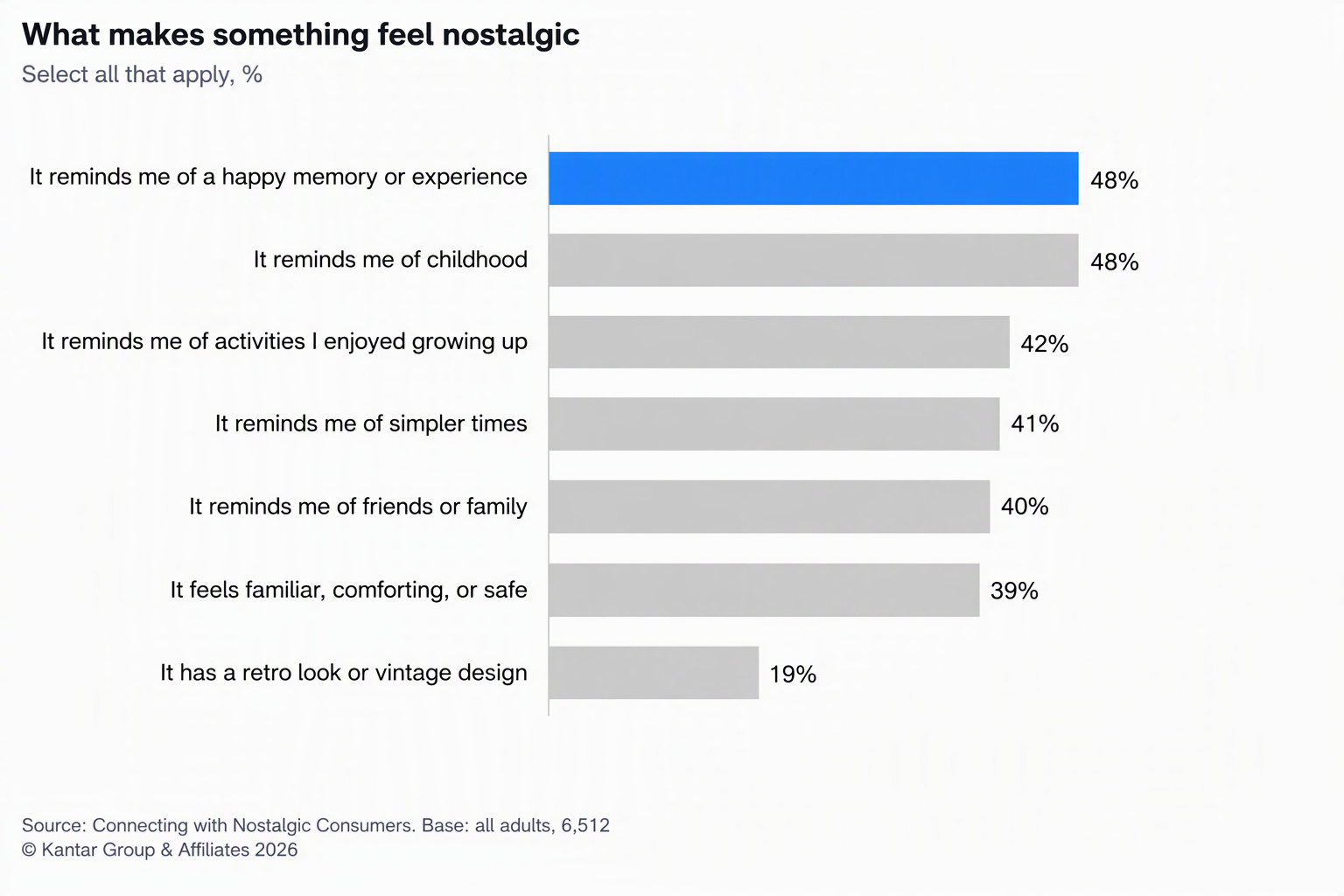
That distinction matters. For brands hoping to tap into nostalgia, recreating the aesthetics of another decade may catch the eye, but creating an emotional connection means understanding the memories behind them.
Childhood is nostalgia’s emotional center of gravity
Ask different generations to name their favorite era for toys and games and they don’t all gravitate towards the 1980s, 1990s or any other universally "nostalgic" decade. Instead, each generation tends to favor the period corresponding with its own childhood.
For Gen Z, the 2000s are the most popular era for toys and games, selected by 31%. Millennials are most likely to choose the 1990s (34%), Gen X the 1980s (37%), and Boomers and the Silent Generation the 1970s (28%).
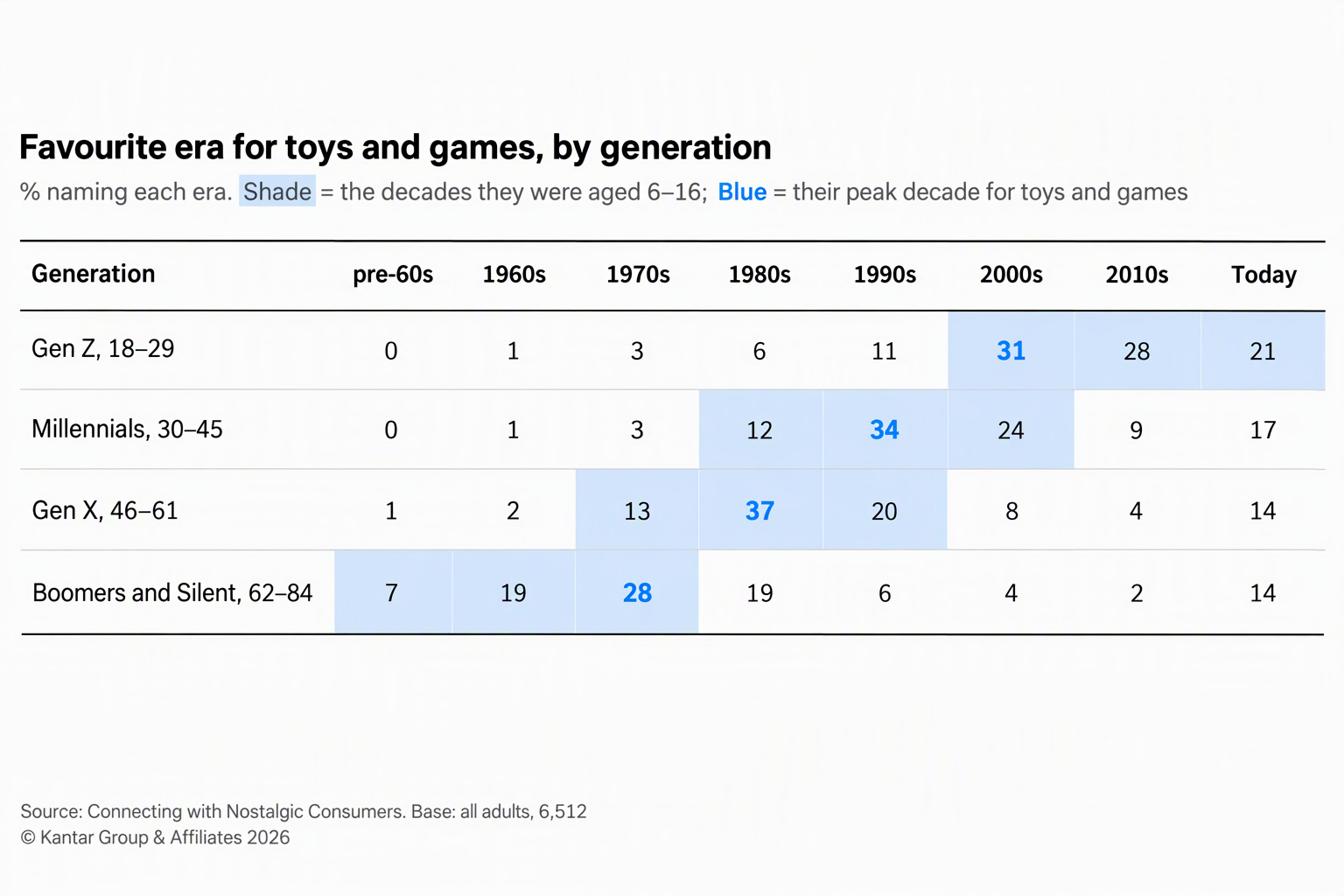
In other words, nostalgia has a clock.
Its hands move forward with each generation. What feels nostalgic isn’t determined by how objectively "retro" something is. It is shaped by where people were at a particular moment in their lives.
Another finding reinforces this connection. When asked at which age they were happiest, 68% of consumers chose a point before they turned 18, with 36% specifically selecting ages six to 11. Only 13% chose their current age.
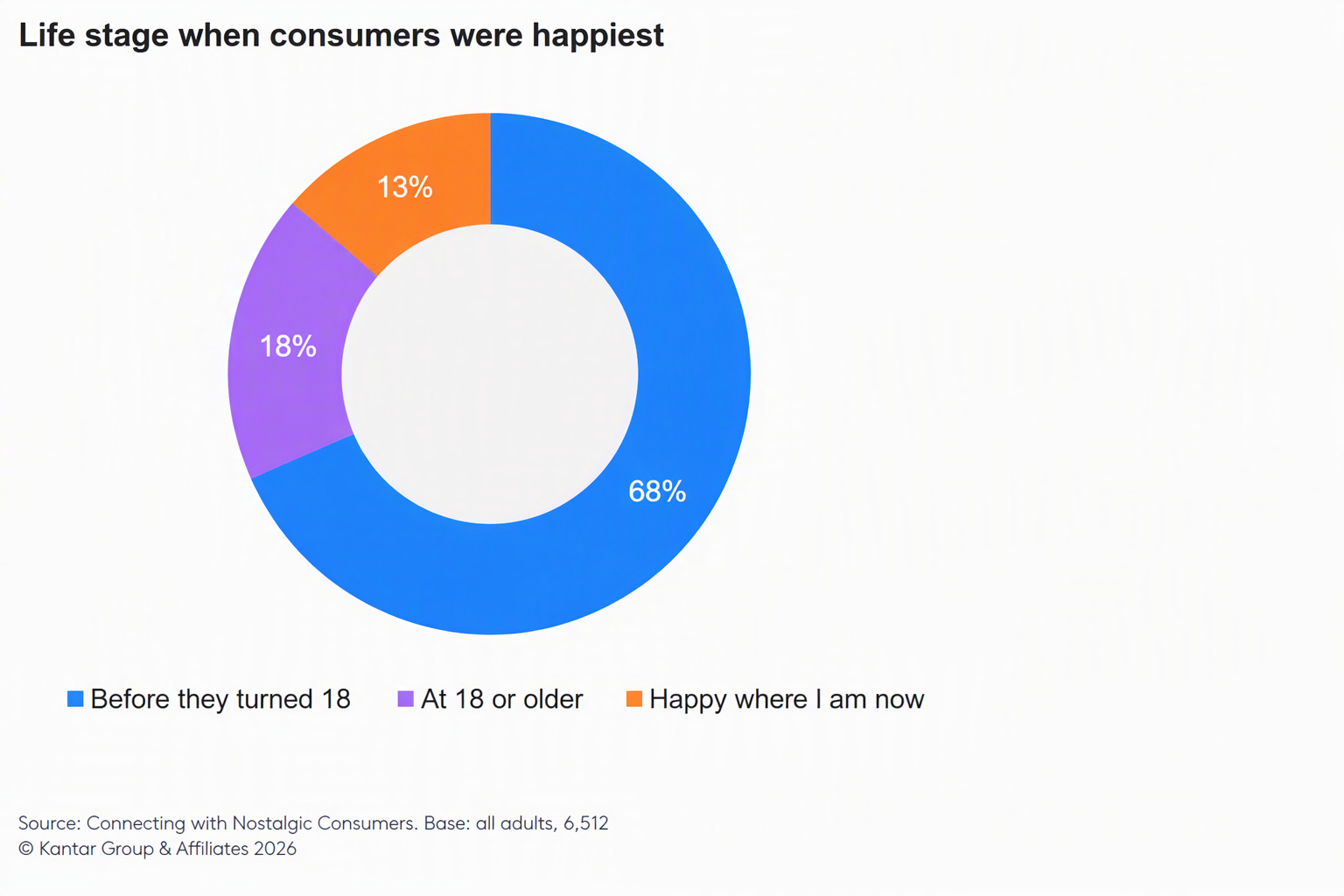
For marketers, that means there is no single nostalgia playbook. The 1990s may hold powerful memories for a Millennial audience, while the 2000s or even 2010s can now play the same role for Gen Z. In fact, 28% of Gen Z already name the 2010s as their favorite era for toys and games, suggesting the nostalgia window can open surprisingly quickly.
The nostalgia clock doesn't run everywhere
The connection between childhood and nostalgia becomes even more interesting when we look across categories.
Kantar asked consumers to select their favorite era across eight different categories. For toys and games, music, TV shows and films, the generational clock appears: different generations tend to select eras associated with their own younger years. But with clothing, cars and bikes, art and books, that pattern largely disappears, with consumers tending to favor the present day instead.
That tells us something important about what makes nostalgia work.
Cultural cues connected to experiences and memories seem much better placed to activate nostalgia than design cues alone. A familiar soundtrack, character, film or toy can take someone back to a particular moment in their life. Making something look old does not necessarily do the same thing.
Consumers themselves reinforce this distinction. Alongside the 48% who associate nostalgia with happy memories and the 48% who connect it to childhood, 42% say nostalgia comes from activities they enjoyed growing up, 41% from memories of simpler times, and 40% from friends or family. Retro or vintage design, at 19%, sits at the bottom of the list.
From retro styling to emotional territory
Rather than simply borrowing from the past, brands should think about the memories and experiences that have real meaning for their audience.
That distinction can have commercial value. Sixty-eight percent of consumers say they are more likely to purchase a product if it reminds them of their childhood or younger years, while 60% are willing to pay more for products that evoke positive memories from their past. Seventy-one percent also say familiar brands from the past make them feel more confident in their purchase decisions.
And nostalgia doesn't require brands to reproduce the past exactly. Nearly nine in ten consumers are open to nostalgic products in some form: 43% like original vintage and newly produced retro products equally, 22% prefer newly made products inspired by the past, and 24% favor original vintage items. Only 11% prefer neither.
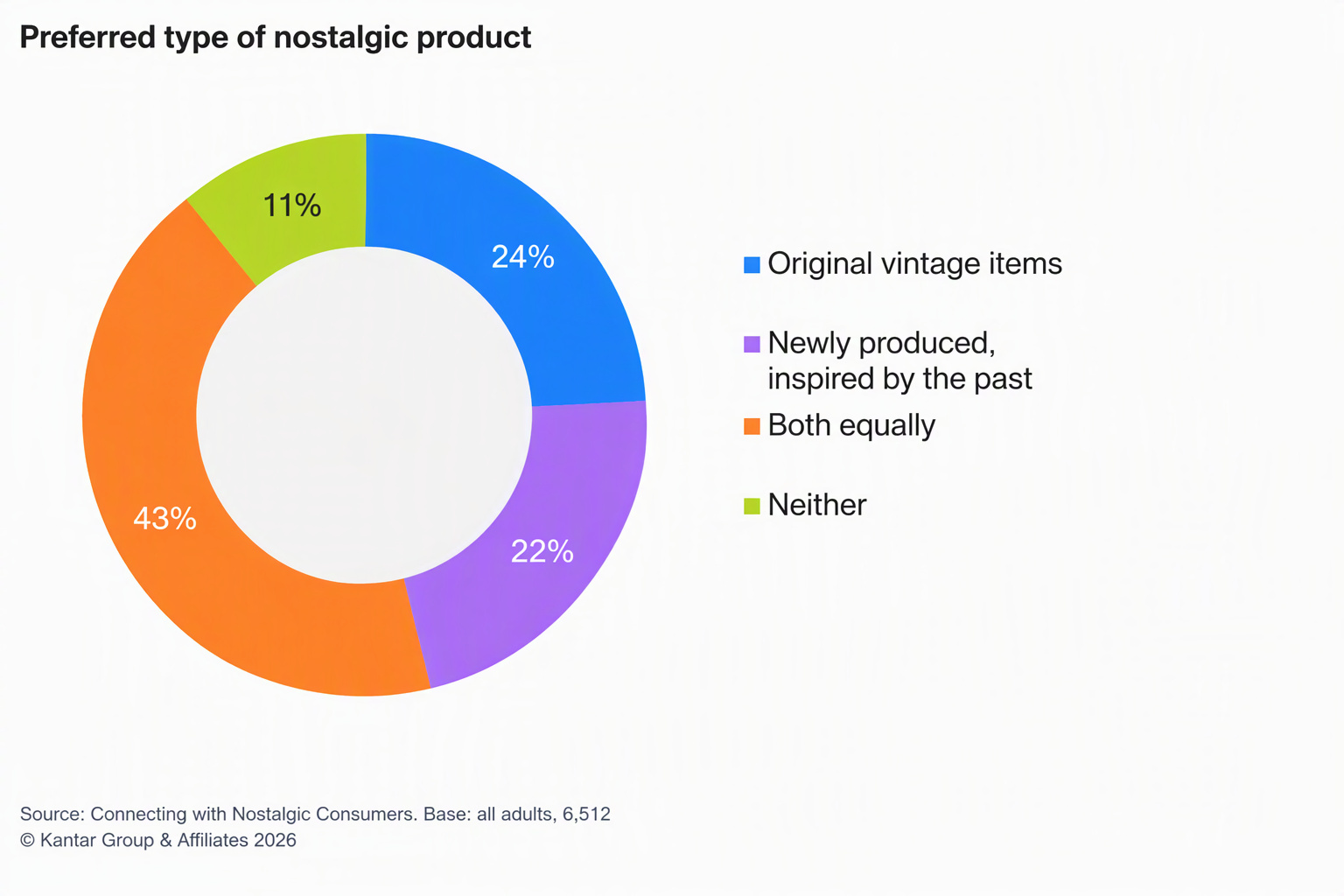
The opportunity lives in identifying the emotional territory from the past that matters to a particular audience and that makes it relevant today.
Making nostalgia meaningfully
Nostalgia can be powerful because it connects products and brands to something consumers already value: their own experiences.
But the data suggests that connection has to go deeper than design. The memories consumers hold onto are often rooted in childhood, family, entertainment and experiences. And because every generation grew up at a different time, the cultural references capable of unlocking those memories are constantly moving forward.
For marketers, that means starting with the memory rather than the aesthetic. Understand which moments, experiences and cultural cues matter to your audience, why they matter, and where your brand has a credible role to play.
Because the strongest nostalgia isn’t just about how something looked. It’s about how it made you feel.
Get more answers
Explore the full report, Connecting with Nostalgic Consumers to discover how nostalgia shapes preference, purchase decisions and willingness to pay, and where brands can turn emotional connections into opportunities for growth.
About this study
The study research is based on an online survey of 6,512 adults aged 18 to 84 across 13 markets: Australia, Brazil, China, France, Germany, India, Japan, Mexico, Singapore, South Africa, South Korea, the UK and the US. Interviews were conducted from 3 to 27 August 2026.