

Demand rarely disappears. More often, it moves beyond the categories, competitors and occasions your business has chosen to track.
Your growth plan may be working exactly as designed. That could be the problem.
Once a business sets its priorities, it begins to optimise around them. Teams track familiar competitors, focus on established occasions and measure performance within recognised categories.
This creates focus, but it also creates boundaries. Demand that falls outside them can become difficult to see.
Most businesses aren’t losing because people no longer have the need. They’re losing because people are satisfying it somewhere else. That could be through another product, a service, a new behaviour or a decision not to consume at all.
Demand rarely disappears. It moves out of view.
Market definitions can create strategic blind spots
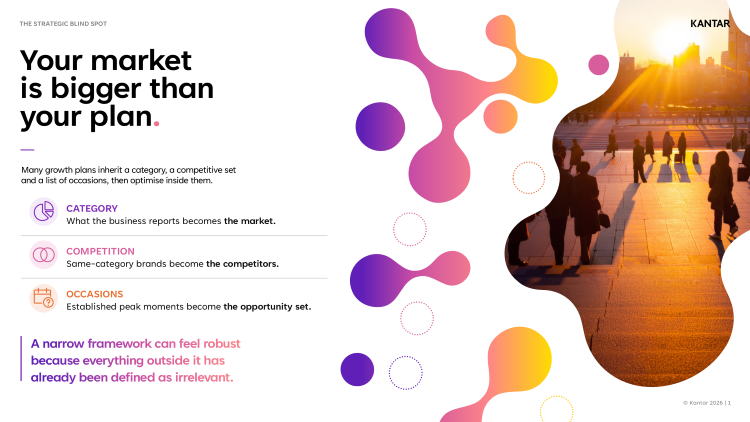
Every growth plan begins with a definition of the market. The business decides which categories to report, which competitors to monitor and which occasions to prioritise. What the business reports becomes “the market”. Same-category brands become “the competition”. Established moments become “the opportunity”.
These choices are necessary, but they are still choices. People don’t organise their lives around industry categories or corporate reporting structures. They choose the solution that best meets their needs.
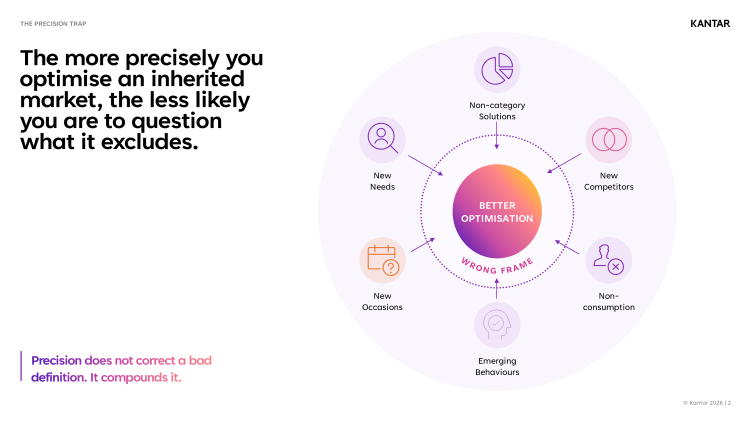
This creates a precision trap. The more effectively a business optimises within an inherited market, the less likely it is to question what that market leaves out.
Precision cannot correct a poor definition. It compounds it.
Meaning can move before performance does
A brand can become better at competing within its category while becoming less relevant to the demand beyond it.
The warning signs may not appear immediately. Awareness can hold. Distinctiveness can hold. Share can hold. Meanwhile, people’s expectations may be changing, and other solutions may be becoming more relevant.
This is why Meaning (a measure of how relevant and resonant a brand is to people) matters as an early signal. By the time sales and market share make a shift impossible to ignore, another solution may already feel like the natural choice.
Kantar evidence points to the value of taking a broader view:
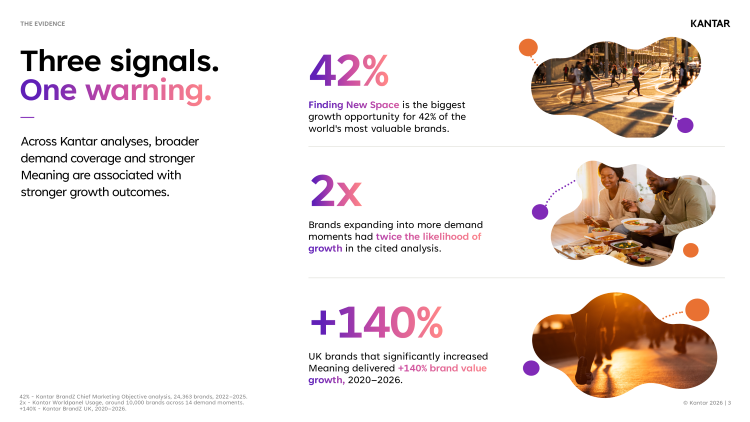
- Finding New Space is the biggest growth opportunity for 42% of the world’s most valuable brands.¹ Their advantage is not simply better execution within a category, but a different view of what the category includes.
- Brands that expanded into more demand moments had twice the chance of growth² of those whose coverage contracted.
- UK brands that significantly increased Meaning delivered 140% brand value growth between 2020 and 2026.³
These findings come from different analyses and shouldn’t be interpreted as a single causal claim. Together, however, they show an important pattern: broader demand coverage and stronger Meaning are associated with stronger growth outcomes.
The strategic question is not only how well a brand is performing in the market it currently measures. It is whether that market still reflects the demand people are trying to satisfy.
Looking beyond established boundaries can reveal different routes to growth
Sometimes the opportunity comes from recognising what truly competes for demand. At other times, it comes from extending a brand into spaces where it already has permission to play. Monzo and Baileys show how these two routes can work.Monzo extended brand permission
When Monzo launched in 2015 as one of the UK’s first app-only banks, it attracted millions of downloads. Yet many customers continued to pay their salary into a traditional bank account.Through a conventional category lens, the task might have been to secure more card transactions or compete through additional banking products. The larger challenge was behavioural: customers still relied on established banks to manage their everyday money.
Monzo therefore focused on the jobs people needed help with between paydays. Features supporting budgeting, bill splitting and cash-flow management made the service useful across more financial moments. Between 2019 and 2026, Monzo's UK Meaningful Index rose by 42%.⁴ A focus on everyday relevance helped Monzo move from being a useful card in someone’s wallet to becoming a credible main bank account.
Baileys redefined what competes
Baileys faced a different challenge. It was a successful brand in a category with limited headroom. If the business had defined the opportunity only through cream liqueur, its growth options would also have remained limited. A wider view revealed that Baileys could address a broader demand for adult treating.Mapping this demand by occasion and behaviour, rather than product category, brought new competitors and opportunities into view. Hot chocolate, ice cream, chilled desserts and smaller formats could all satisfy a similar desire for accessible indulgence. The opportunity was to make Baileys relevant whenever people wanted an adult treat.
That shift expanded the occasions the brand could serve without abandoning what made it distinctive. Baileys had credible permission to move because indulgence was already central to what the brand meant to people. Its UK Future Power score rose by 10 points between 2015 and 2026.⁵
Different moves. Same discipline: define the demand before defending the category.
The principle extends beyond these two brands and categories. Uber recognised a wider demand for speed and ease, which opened a path into food and groceries beyond its original transport frame. Zara responded to changing expectations around newness, fulfilment and connected shopping, expanding into adjacent spaces its customers were already buying. Different sectors, same starting point: the demand people were trying to satisfy, not the category the business already recognised.A broader view is not permission to pursue every possible adjacency
Monzo’s opportunity made sense because the brand could help customers with more everyday financial tasks. Baileys could broaden its role because adult treating was consistent with its existing meaning.
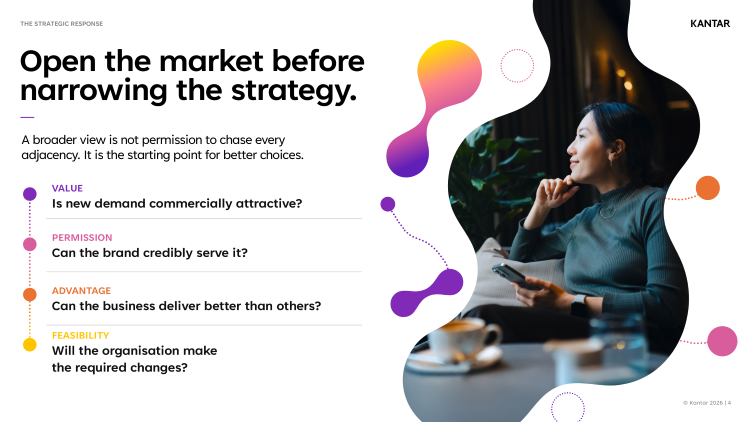
The purpose of opening the market is to make better choices. Any potential opportunity still needs to pass four tests to distinguish an attractive possibility from a credible growth opportunity:
- Value: Is the demand commercially attractive?
- Permission: Can the brand credibly serve it?
- Advantage: Can the business deliver it better than others?
- Feasibility: Will the organisation make the changes required to win?
These tests prevent a broader demand lens from producing an unfocused strategy. The aim is not to make the growth plan broader. It is to widen the field of vision before deciding where to focus.
Challenge the frame before building the next plan
Before investing in another map of a familiar market, leadership teams should begin by asking what the plan leaves out:1. What demand do our current category and competitor definitions exclude?
2. What else is already satisfying, replacing or removing that demand?
3. Where could our brand credibly serve it?
4. What would have to change for us to win?
These questions alter the starting point for growth. Instead of beginning with the products the organisation already sells, they begin with the needs people pursue. Instead of looking only at recognised competitors, they consider every solution and behaviour that could replace consumption.
The market will not wait for reporting structures to catch up. If a growth plan looks only at established categories, competitors and occasions, it may be measuring the consequences of yesterday’s choices rather than the sources of tomorrow’s growth.
Somebody may already be growing through demand you decided wasn't part of your market. How long will it take before that growth appears in the data you currently watch?
Your market is bigger than your definition of it. The question is whether your growth plan is.
Kantar helps organisations look beyond established market boundaries, understand changing brand relevance and identify growth that their current definitions may not reveal. Contact Jade McMillan-Hainey to explore what your growth plan could be leaving out.
¹ Kantar BrandZ Chief Marketing Objective analysis, 24,363 brands, 2022–2025. ² Kantar Worldpanel Usage, approximately 10,000 brands across 14 demand moments. ³ Kantar BrandZ UK, 2020–2026. ⁴ Kantar BrandZ UK Banking, Meaningful Index, 2019–2026; Monzo Annual Report / Monzo investor communications. ⁵ Kantar BrandZ UK Spirits, 2015–2026; Diageo Stories, February 2025.