A year after US President Donald Trump launched his initial trade war on Canada, and shortly after he renewed it, one question remains: Are Canadians still choosing to buy Canadian?
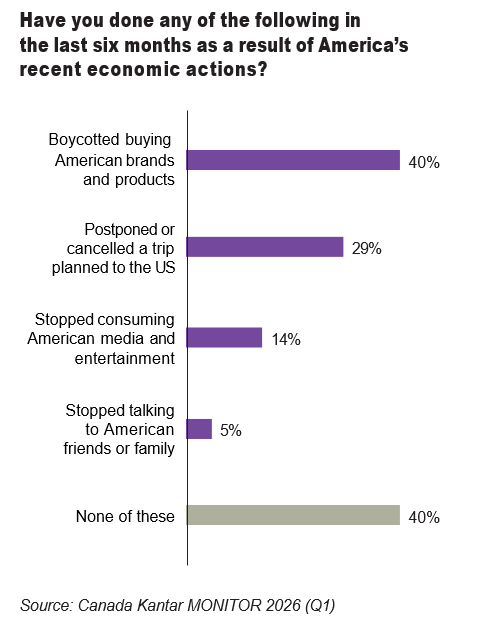
According to Kantar MONITOR data from Q1 2026, 40% of Canadians continued to boycott American brands and products, and 29% were still postponing or cancelling US travel. This indicates that the Buy Canadian movement was still going strong until recently.
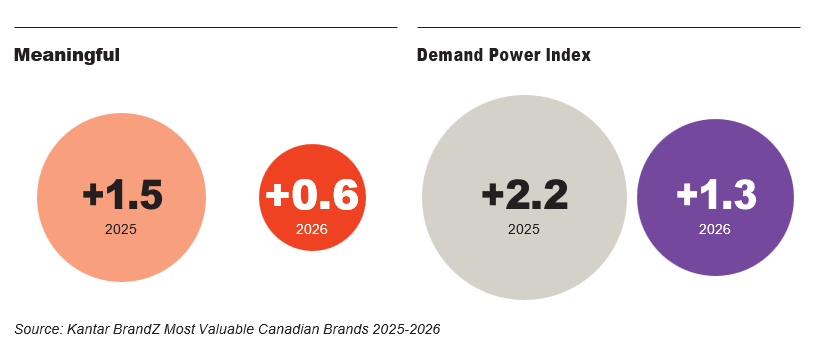
However, cracks were showing. In 2025, the average Canadian brand had become more Meaningful to Canadians, which resulted in enhanced predisposition. But while the average Canadian brand continued to be more Meaningful in 2026, the impact of this was not as significant as a year earlier. This suggests that previous behaviours may have been starting to return, and the impact of Buy Canadian was not as strong as it was at the beginning of the trade war.
In fact, the number of Canadians stating they were buying more Canadian and fewer American products, while still high, declined at the end of 2025, again indicating that early buying patterns were making a comeback.
. Series: Spending more on Canadian goods; Spending more on Canadian vacations; Spending less on US goods; Spending less on US vacations. Periods: Q1 2025, Q2 2025, Q3 2025, Q4 2025.</p>
<p>Note: Respondents in the Canadian Survey of Consumer Expectations were asked,)
So, how are growing brands responding? The simple answer is that they are not relying on Canadian heritage alone; rather, they are standing out in their categories for something additional.
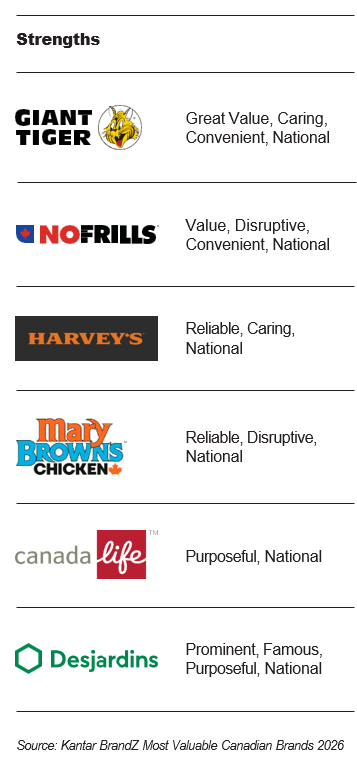
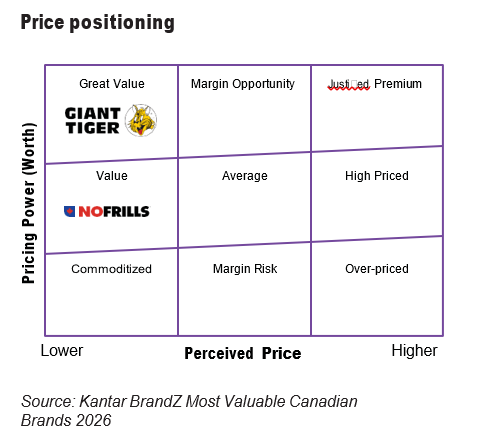
For example, Harvey's and Mary Brown's Chicken are seen as reliable brands; Giant Tiger and No Frills deliver great value; Canada Life is seen as purposeful; and Desjardins is considered prominent and famous.
Both Harvey's and Mary Brown's Chicken are continuing to expand and open new stores, making it easier for Canadians to choose Canadian fast-food restaurants. They also position themselves in ways that distinguish them from their competitors. Harvey's focuses on customization and fresh, Canadian ingredients, putting a local spin on the traditional burger joint. Mary Brown's Chicken highlights menu innovation and is partnering with former Toronto Blue Jays player José Bautista to lean into Canadian baseball pride. Such efforts are helping these brands stand out with a uniquely Canadian identity, making it easy for consumers to choose them over non-Canadian options.
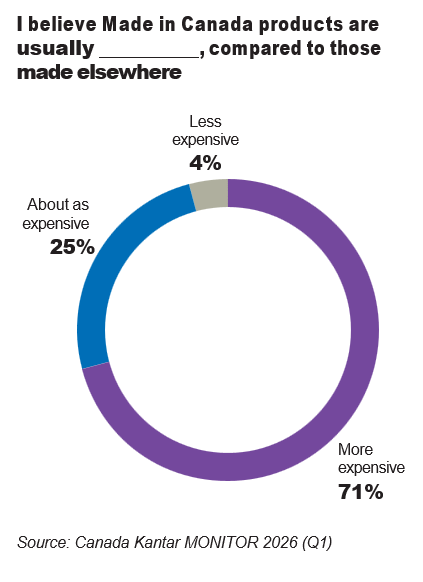
With inflation at a multi-year high, affordability remains a major concern for many Canadians. As a result, price remains the largest barrier to the Buy Canadian movement, with 71% of consumers perceiving Canadian-made products as more expensive than alternatives.
In such an environment, brands that deliver on both value and their Canadian heritage have a distinct advantage. For example, Giant Tiger and No Frills excel on both measures in the general retailers and grocery stores categories, respectively
According to Kantar BrandZ, the former continues to stand out as a great value retailer, which has contributed to its growth this year. No Frills is another Canadian brand leaning into value, highlighting this approach strongly in 2026 with its "No Frills Yes Savings" positioning.
One category where Buy Canadian remains strong is travel. In 2025, Canadian travel to the US dropped 25.4% from 2024. In 2026, it has recovered somewhat, with a 3.2% increase in June compared to the previous year. US travel searches were also up 16% in the first half of the year, though this may have been due to the World Cup. Travel behaviours are also shifting, with Canadians stating that they are more conscious of where they go in the US. Many are opting to visit Democratic states, and others are booking more flexible options to cancel if needed. Such shifts may have a longer-term impact on US travel.
Finally, many grocery stores continue to display "Made in Canada" and "Product of Canada" labelling on their shelves, making it easy for consumers to choose a homegrown option when available.
What's next?
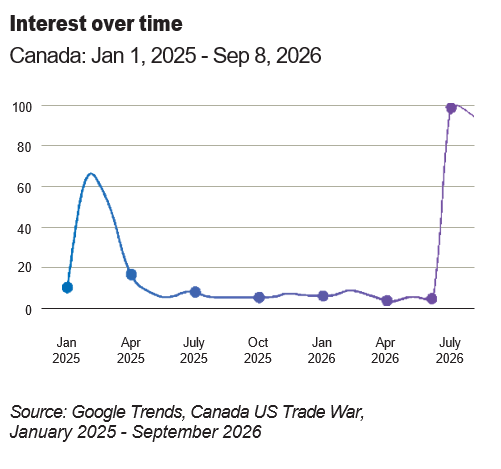
The resurgence of the trade war in August 2026 is likely reigniting the Buy Canadian movement. After seeing fewer searches for "Canada US Trade War" in the second half of 2025 and first half of 2026, interest in the terms reached a new peak in August and September. That makes it clear that to keep standing out and sustain equity long-term, Canadian brands should continue focusing on their distinct brand values.
Conclusion
Today, Canadians are making a conscious effort to buy Canadian when they can and limit travel to the US. But with even the recent increase in tariffs, Canadian brands cannot rely on their heritage alone. Instead, they must also build a point of distinction in their categories to drive consumer choice. They should continue to pair heritage messaging with distinctive brand values to differentiate themselves from their competitors and build sustainable growth over the long term. This is especially relevant with the current state of the economy, in which Canadians are often opting for better value options, regardless of the country of origin. Brands that highlight their strengths and deliver on value will remain at a significant advantage.
View the full 2026 Kantar BrandZ Most Valuable Canadian Brands report here.