Have you ever found yourself unable to pay because a shop’s payment system was down? Or perhaps, more chillingly, discovered that your child’s nursery had suffered a data breach? Maybe you’ve arrived at work to find you couldn’t log on because your company has been held to ransom.
One estimate puts global cybercrime costs at $10.5 trillion per year and rising. As hacking becomes increasingly pervasive, how is it affecting people’s trust in brands? And what can organizations do to stay ahead of these threats while keeping customers and their data safe?
To explore this, we conducted an omnibus survey to understand consumers’ concerns and what they expect from companies if the threat becomes real.
How concerned are consumers about hacking?
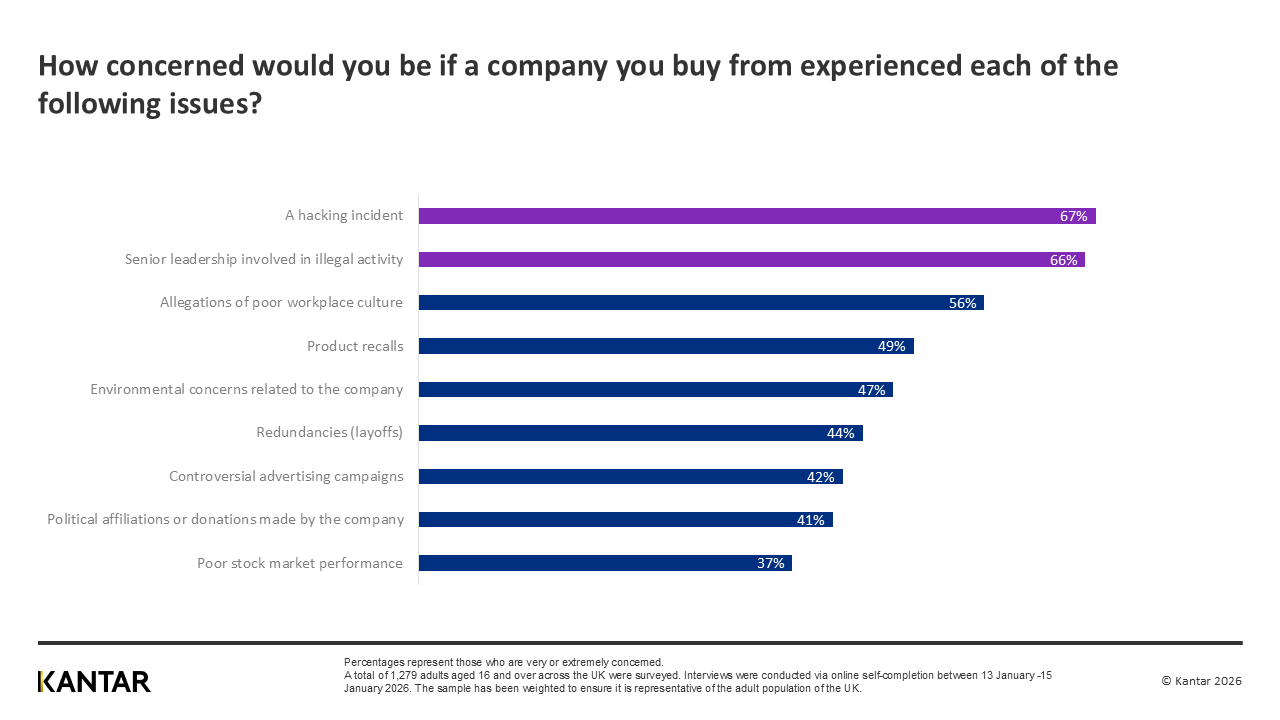
To put hacking into context, we asked respondents how different issues compared for the companies they buy from. This included things like a hacking incident, senior leadership being involved in illegal activity, allegations of poor workplace culture, and product recalls.
The results were striking. Hacking ranked as one of the top concerns, with two-thirds of consumers saying they would be concerned if a company they bought from was affected by one. This placed it on par with senior leadership being involved in illegal activity, highlighting just how damaging cyber incidents can be to brand reputation. Concern about hacking was notably higher than issues like poor stock market performance, political affiliations or donations made by the company.
One in five also said they are extremely concerned about brands being hacked in the next 12 months. A similar proportion (17%) would be unlikely to continue using a brand’s products or services following a hacking incident.
No sector feels safe
Consumers most often pointed to social media companies (62%) and apps (59%) as who they felt was most vulnerable, reflecting how much personal data these platforms hold.
However, concern is not limited to these sectors. Across all industries, at least four in ten people sense vulnerabilities.
And when money is involved, tolerance for risk drops sharply. Financial services organizations are the most likely to lose customers after a cyberattack: nearly two-thirds of consumers (64%) would be likely to stop using banks or insurance providers if this happened.
But all brands should take note. For every industry in the research, close to half or more of respondents would stop using a brand after a hacking incident, underlining the potential severity of the commercial impact.
What this means for brands
People are prepared to walk away from brands that fail to protect their data or respond effectively.
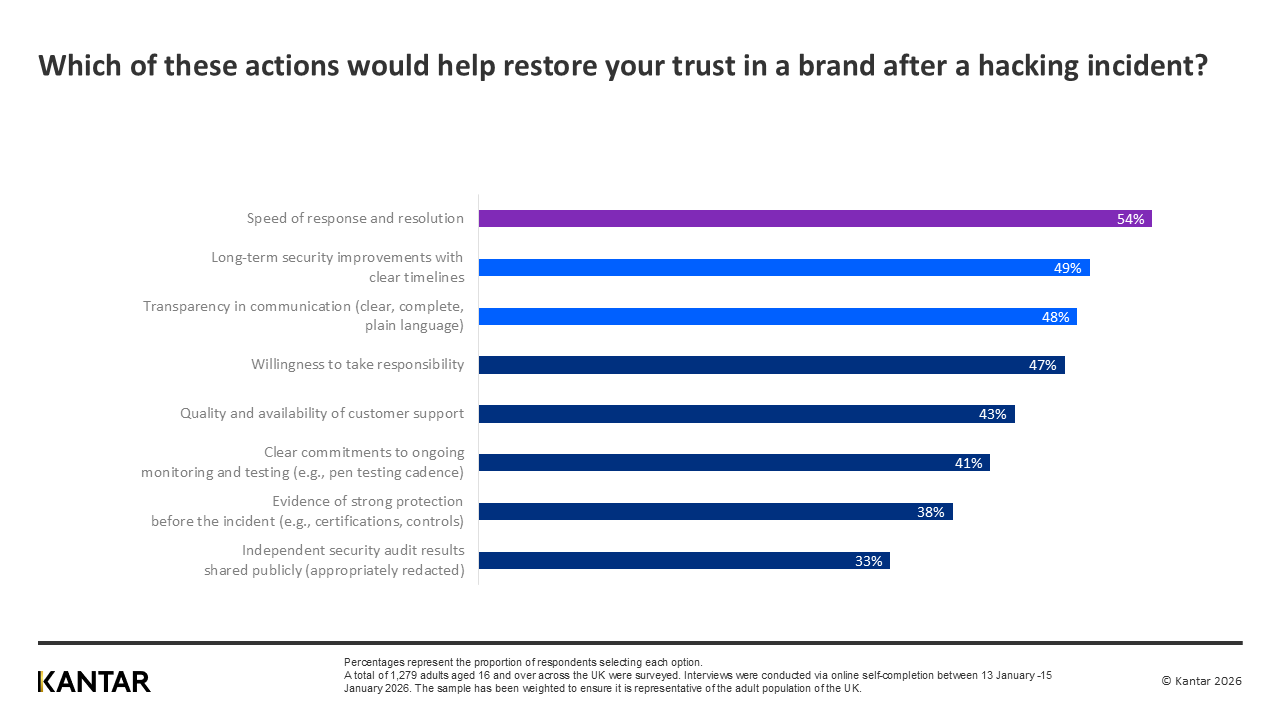
More than half of consumers say that a brand’s response to a hacking incident directly affects how much they trust that company (52%). Restoring that trust – and that customer base – is a slow and expensive exercise. So while prevention is critical, so is the cure.
Understandably, the top priority is a fast response and resolution (54%). But people don’t like being left in the dark, and nearly as important is clarity on the long-term security improvements being put in place, including clear timelines (49%) and simple explanations about what happened and what data may have been affected (48%).
How a company responds makes all the difference. As one consumer puts it, swift and transparent action can preserve trust: “I would continue using the brand if they responded quickly, were transparent about the issue, and took strong security steps to prevent future incidents.” [man, 18-24]. Another consumer highlights the importance of accountability and explanation: “The majority of the time, it is not their fault and the hackers are just better than their security. Most take responsibility, outline the steps taken and what they're going to do to prevent it from happening again.” [woman, 25-34]
And if there’s one thing BrandZ’s 20 years of evidence have made unequivocally clear, it’s this: brands that invest in trust through consistent delivery, transparency, and a meaningfully different experience not only withstand crises but emerge from them stronger.
Today, cybersecurity is one of the most critical arenas where that resilience is being tested, and no brand can afford to treat cybersecurity as background noise. Clear preparation, rapid response, and transparent communication are essential.
Want to learn more?
This research was conducted by the Profiles team at Kantar via an omnibus survey. Omnibus research blends cost-effectiveness, flexibility, and speed to stay abreast of shifting consumer attitudes and opinions. Learn more about omnibus surveys here.
Discover our full suite of Research Services and Survey Solutions to get representative and reliable consumer data in as little as one week.
Methodology
A total of 1,279 adults aged 16 and over across the UK were surveyed. Interviews were conducted via online self-completion between 13 January -15 January 2026. The sample has been weighted to ensure it is representative of the adult population of the UK.