New space is opening inside the shopping moment. Retail media networks, live commerce, in-app checkout, AI-mediated discovery and creator-led shopping are all creating occasions that did not exist five years ago. Commerce is now inserting itself into media as an integrated, authentic element.
Ad formats that sit close to the point of sale are usually bought as conversion or performance tools. But their contribution to growth relies on how predisposed people are to the brand to start with, or whether the ad itself is branded well enough to do any predisposing. Being close to the transaction doesn't create that on its own.
In our Blueprint for Brand Growth, our analysis of 6.5 billion consumer data points over 10 years, we call this Be More Present. It’s about your brand being easy to buy - showing up in more moments, more places, more of the occasions where the category gets chosen. Retail media networks, commerce ads and social commerce are literal expressions of that idea, meaning there are now many more opportunities to put the brand in the right place at the moment of choice.
If people arrive at the point of purchase with little predisposition towards the brand, presence may secure an immediate transaction, but it is less likely to build lasting demand unless the experience also strengthens the brand.
Put plainly: Being more present at the point of purchase is highly effective at converting existing demand. But when retail media is planned only as a performance channel, its potential to create future demand is often left to chance.
Retail media is a strong brand-building channel
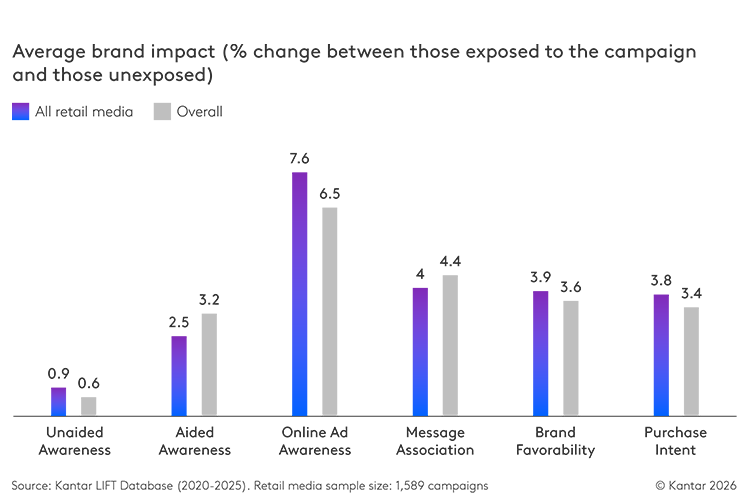
We examined 1,589 campaigns that included retail media as a channel in our LIFT database and found that this relatively new channel is already punching above its weight. Retail media performs 10% better than an average channel in increasing purchase intent and 9% better in brand favourability, both KPIs that matter closely for sales. It is also 16% better at creating online ad awareness, and performs almost at double impact for unaided awareness, coming from a smaller base. Although retail media delivers less impact on aided awareness and message association, marketers should not view it solely as a performance channel. It also contributes to brand building, making it an important driver of long-term growth.
Commerce ads build brands and they build it at scale. Two out of three consumers are exposed to social commerce, and two out of three consumers are exposed to ecommerce ads, according to Kantar’s Media Reactions, equal to the claimed reach of broadcast TV ads. In addition, ads in physical stores are consumer favourites, contributing to the success of retail media networks, which include both online and offline touchpoints.
Commerce media is well-received by consumers both at a general and specific level; Amazon is the consumer favourite among global ad platforms. Three of the Amazon ecosystem brands make up the top five, with Twitch and Prime Video at ranks four and five. Consumers enjoy the ad experience the retail media giant provides. Being able to leverage rich, first-party consumer purchase data helps Amazon deliver an advertising experience that consumers welcome, as they also continue to stand out as one of the platforms with the most relevant and useful ads.
Social commerce contributes to long-term brand equity
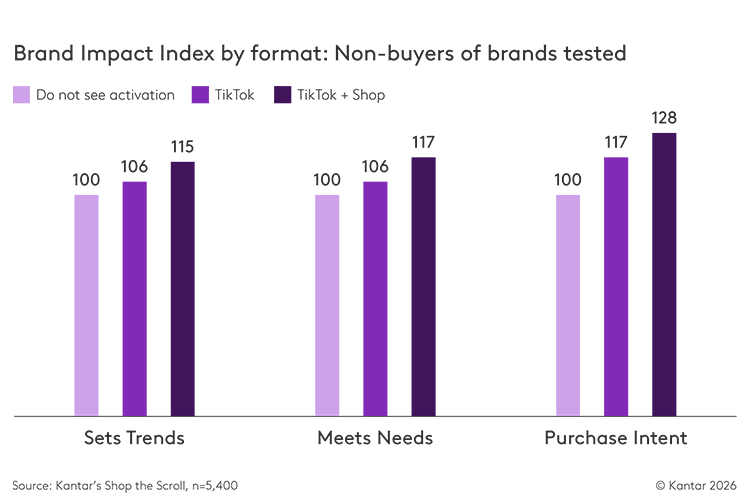
Another great example of how commerce can help build brands comes from social media. We conducted a 27+ ad study for L’Oreal and TikTok across three markets to determine the specific impact of TikTok Shop. Looking at non-buyers of the brand, while the traditional TikTok strategy contributes to the brand, a connected strategy that includes TikTok Shop brings gains on purchase intent and important brand equity levers, sets trends and meets needs. People then go and purchase the products both online (TikTok shop and elsewhere) and in physical stores. Rather than cannibalising offline shopping, online enhances it.
The AI layer is the new frontier in the consumer journey
As AI assistants become mediators of discovery, a social or ecommerce-only strategy is too narrow to ensure your brand’s visibility on the digital shelf.
Our research shows that 21% of AI-assistant users turn to them for help with a product or service. As these tools become part of discovery and decision-making, brands need to understand where and how they are being surfaced, while validating these signals against consumer attitudes and behaviour. And this strategy can’t be all about social media or Reddit. Reddit may be the biggest citation source on AI assistants, but its share is only between 2% and 9% in one category, according to our analysis. AI presence needs its own focus to ensure your brand is present on relevant point-of-sale channels for maximum availability to consumers. And these plans can’t be made in isolation - they need to be connected.
So what are the next steps for CMOs?
Brief your commerce creative the same way you would brief any brand campaign: distinctive assets in the first frame, a consistent idea across all formats, and success metrics that take account sales and brand impact.
Point-of-sale has long been siloed in marketing plans, despite strong consumer sentiment and its closeness to the point of purchase. But its online or offline capabilities go beyond promotion and short-term sales support. Connect your brand’s comms strategy across retail media, social commerce, and AI and through to your traditional channels. A net 35% of marketers are planning to increase their investment in retail media in 2026, while this figure rises to 53% for social commerce.
Here are four ways to take full advantage of the strength of point-of-sale channels:
1. Collaborate with retailers to analyse their first-party data for more targeted and relevant advertising.
2. Tailor creative to align with the specific consumer segments identified.
3. Make creator briefs clear but allow for creative freedom.
4. Measure the brand impact of your investment for humans and machines. Brands must be meaningful and different to both audiences.
Discover how to unlock more value from your media plan: https://www.kantar.com/solutions/decision-intelligence/media