The media landscape is more fragmented and complex than at any point in history. Audiences are dispersed across platforms, formats, and moments, yet many measurement systems still reflect assumptions from a much simpler era. Rather than being designed for today's realities, many have evolved incrementally over time, layering new features onto old frameworks instead of reimagining measurements around modern business needs.
This isn't only a technology problem. It is more a decision-making problem. Marketers are being asked to navigate an increasingly complex ecosystem using measurement frameworks designed for a far simpler world. This disconnect becomes especially clear in one of the questions I hear most often from clients: "How much is too much?"
Historically, we answered this question through channel-level response curves that showed how returns changed as spending increased. Yet in a world where each channel is an ecosystem of hundreds of publishers, formats, and tactics, can a single aggregated response curve really tell us where the next dollar should go?
Now, don’t get me wrong. Response curves are important and matter as much as they mattered in the past, but their role has fundamentally shifted. They are no longer static rulers used to cap spend within a single channel. They are dynamic maps that reveal how channels interact, amplify, and reshape each other through synergy. In this environment, optimization is not about individual channel efficiency, instead it is about a decision intelligence that requires careful orchestration of a whole ecosystem.
A sophisticated optimization engine is now table stakes to manage this complexity. But is mathematical optimization alone sufficient? The most effective outcomes emerge when machine-driven computational truth is continuously reviewed, challenged, and refined by seasoned experts who bring business reality, outside-in context, and strategic judgment to the table.
1. Fragmentation has changed the meaning of response curves
In today’s ecosystem driven marketing environment, no channel operates independently. A video impression does not “end” with awareness; it primes future search, lowers downstream CPA, and extends the life of other investments. The media consumption is also not binary anymore, people watch TV with a device in their hands, stream traditional TV content on mobile devices, further blurring the lines between channels. As a result, the response curve of any single channel is incomplete when viewed in isolation.
Historically, marketers looked for the saturation point of a channel where diminishing returns begin. In a fragmented system, the more important question is how the asymptote of one channel is pushed higher by the presence of another. This is the shift from static curves to dynamic asymptotes.
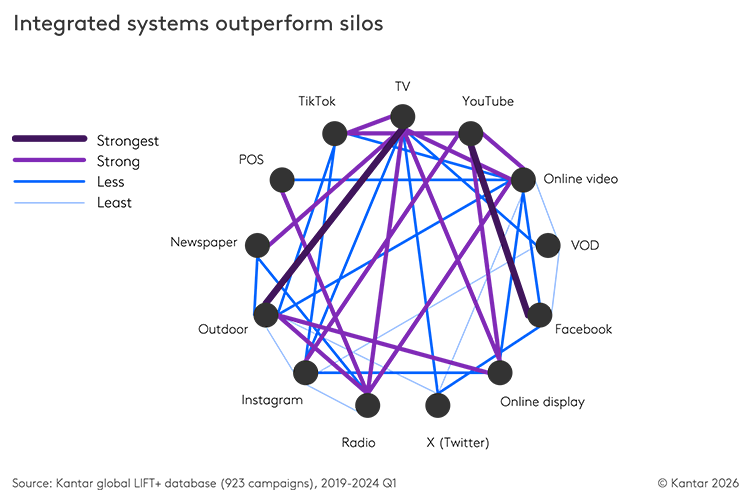
Synergy is playing out everywhere. And we have the methods to mathematically prove that integrated systems outperform silos, where 1 + 1 = 3.
Kantar ran a study analyzing 923 campaigns evaluated the synergy across different channels and their relative strength. The chart below captures the complexity of today’s media landscape and why effective measurement can no longer rely on simplistic approaches, demanding more sophisticated solutions to accurately measure and optimize business outcomes.
2. A sophisticated optimizer is now required because it can:
With 10-15 channels, hundreds of publishers, and thousands of tactics, the system quickly becomes impossible for human intuition to solve. The number of interaction effects grows exponentially. This is the curse of dimensionality.
- Handle non‑linear response and identify true inflection points
- Run thousands of simulations to solve for the best overall plan, not just the best channel-by-channel answer
- Detect invisible synergies and lead‑lag relationships humans cannot see especially at scale Optimize for balancing both short- and long-term impacts, while controlling for creative quality
The optimizer produces a mathematically reality based on historical data that maximizes the impact of your media plan.
3. But, is mathematical optimization the silver bullet?
Despite its power, a sophisticated optimizer is not a silver bullet as well. Taken at face value, it can produce results that are mathematically viable but may not speak to a sudden change of strategy, radical change in budgets, constraints on truly which tactic can be altered, competitive actions and the intelligence of marketing actions that the brand didn’t consider historically.
The optimizer delivers computational truth devoid of real time context. It is a good and critical starting point, but there is more to be done to deliver maximum value for advertisers.
4. The human “outside-in” advantage
This is where seasoned experts create disproportionate value. The human role has changed from enabling decisions based on 10-20 response curves and to orchestrating the system.
Human expertise provides:
- Improbability filtering – Removing mathematically optimal but operationally impossible plans (e.g., liquidity ceilings, inventory constraints).
- Outside-in context – Injecting competitor moves, cultural shifts, regulatory changes, and supply chain realities the data cannot see.
The expert ensures optimization survives in the real world. In short, the optimization tool is the horse, and the human expert is the jockey.
Now, this muscle can be acquired by training. So, when a user wants to run optimization independently, they just need access to experts who know the pitfalls, how to make assumptions and finally advise on the decisions that truly are meaningful in the context of the market environment.
A recent LIFT ROI engagement, Kantar’s marketing mix modeling (MMM) approach, illustrates this point.
- TV had historically been a strong-performing channel for our client, but the brand was shifting its target audience from older to younger consumers
- Rather than relying only on historic channel-level response curves, Kantar combined optimization modeling, competitive media intelligence, and internal benchmarks to reassess whether the same channel and publisher mix still made sense
- The recommendation translated the analysis into a practical media plan, including the optimal mix of channels and publishers, weekly investment levels, and expected short- and long-term sales impact
- By activating the recommended plan, the client achieved 19% higher returns from marketing investment
5. Iteration is the source of real optimization
True optimization is an iterative loop:
1. Optimizer produces a mathematically optimal plan
2. Expert challenges it with business reality and risk
3. Constraints are refined and scenarios run
4. The plan evolves toward decision‑grade prediction
This process allows brands to answer the most critical question: “How much is too much?” with a dynamic ceiling that can be intelligently expanded through creative refresh, channel rotation, and ecosystem rebalancing.
These principles were recently seen in action with a food and beverage client where the brand was using legacy measurement system that reviewed performance only once a year, relied on broad channel-level response curves, measured ROI in silos, and did not account for creative quality or long-term impact.
- Kantar introduced a more agile and granular framework with quarterly effectiveness reviews.
- The insights were holistic including short- and long-term optimization, publisher and campaign-objective-level decisions, synergy measurement, and creative quality assessment.
- The client’s media agency received direct access to Kantar’s optimizer to run optimizations on the fly
- Kantar’s brand and media experts provided counsel on assumptions and pressure-test the recommendations to provide an actionable optimized media plan
- This process led to a 29% increase in ROI, with the insights elevated to the C-suite
In Conclusion
In a fragmented media landscape, senior marketers should challenge whether their measurement system is truly helping them make better decisions, not just report performance. Use these questions to assess whether your current approach is equipped to optimize the full marketing ecosystem.
- Does your measurement system capture the full picture, including short- and long-term impact, creative quality, and both media and non-media drivers?
- Is it granular enough to support real planning decisions by channel, publisher, campaign objective, and placement?
- Does it account for how channels work together, rather than evaluating each one in isolation?
- Do you have an optimizer that can test thousands of combinations to deliver you maximum impact?
- Do you have expert support to pressure-test the assumptions and turn the output into decisions we can act on?
If your measurement system cannot answer these questions, it is not yet built for decision intelligence. Senior marketers should expect more: a system that explains performance, tests choices, and guides better investment decisions across the full marketing ecosystem.
Explore how Kantar can help with LIFT ROI here.