

Consumers are warming up, but unevenly
Globally, more people are becoming receptive to advertising than ever before as consumers become more accustomed to a broader mix of channels and platforms and marketers get better at creating ads that entertain, feel relevant, and earn their place rather than just interrupting. We saw only 24% ad receptivity in 2020. In 2025, 57% of consumers globally now say they're generally positive towards ads. That's the kind of shift that makes a media planner's job easier, in theory.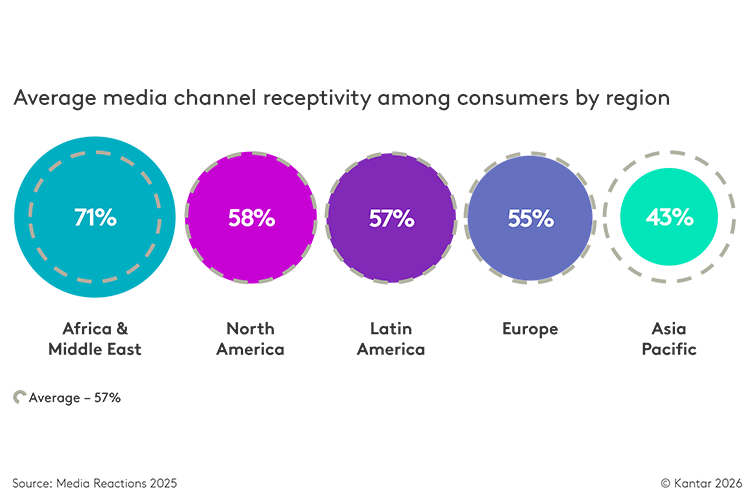
In practice, that 57% hides a lot of disagreement. Africa & Middle East consumers are far more welcoming than anywhere else, at 71%. However, cultural norms do mean we often see more positive responses from consumers in these regions. Asia Pacific sits at the opposite end, at just 43%, but showing a wide diversity across markets within the region: Vietnam, Indonesia, Philippines, China all show very high ad receptivity, while Australia, Hong Kong, Japan and Singapore are less welcoming of advertising. Even neighbouring markets such as the US and Canada show big differences with receptivity towards ads over twice as high in the US compared to Canada.
Consumer, Marketer disparity
The disparity between marketers and consumers is striking, nowhere more so than in print, with the largest difference seen across newspapers and magazines both online and offline. Consumers are welcoming of ads in print, whereas marketers are much more sceptical of placing their ads here, across all countries and regions. At the other end of the scale, marketers tend to favour ads in online videos, a channel consumers are far less favourable towards, particularly in Italy, China and Belgium. Traditional offline formats still win globally overall for consumers, but which formats win changes completely by market.While sponsored events were the number one media channel at a global level last year, within many markets, variation was still evident. Nine different offline channels topped the rankings across markets, Radio in Chile; Cinema in Germany, Japan, the UK; and TV in the Philippines and Thailand.
The consumer versus marketer disparity is also present across platforms. Last year, not a single brand appeared in both the consumer and marketer top five platforms. Consumers favoured ads on Amazon (1st), Snapchat, TikTok, Twitch and Prime Video, while Marketers favoured placing them on YouTube, Instagram, Google, Netflix and Spotify, the same lineup as 2024. It's a gap worth considering; despite Amazon having three brands favoured in the consumer top five, none of these falls in the top five platforms Marketers planned to allocate most budget to.
At the same time, local brands are holding their own against global giants too, regional and national players top the rankings in several markets. Mercado Libre, top in Argentina, Brazil, Chile and Mexico, The Guardian in the UK, DStv Streaming in South Africa, The New York Times in the US, proof that global reach doesn't guarantee local relevance.
Three things to watch heading into 2027
- Social commerce was in marketers' top 5 rankings in 2025, a channel to watch as it matures. Also, a channel showing variation among consumers by market, within Asia big differences are evident, it ranks 8th in Thailand and 11th in China, Indonesia and Vietnam, while falling 22nd in Hong Kong and 21st in Japan out of a list of 25 media channels.
- Creators/Influencers saw continued increase in expected budget allocation by marketers as they become further embedded in brands’ media mix. The highest net positive increases were seen in Africa/Middle East and Latin America, with Asia Pacific average and North America and Europe slightly lower.
- Attitudes towards the possibilities of Gen AI vary by market. 2025 saw increases in net positive attitudes of 10+ in Malaysia, Australia, US, Germany and Italy, while a decrease of 13 was seen in Singapore and 12 in India. On a regional level Europe and North America showed increased positivity, while Asia Pacific overall decreased in positivity towards Gen AI.
Why this matters market by market
Regional averages are a useful headline, but they flatten exactly the differences that make or break a campaign. The marketers getting the most from their media spend in 2027 will be the ones planning market by market, because a channel that's a safe bet in one country can be the wrong call two borders away.
Our full Media Reactions 2026 report will be available on Tuesday 29 September, with complete country-level consumer rankings across 30+ markets, the full global marketer brand rankings, and a detailed breakdown of preference, trust and quality by channel and brand. This year, we also take a deep dive into attitudes towards creators/influencers and the evolving use of AI.
To find out more through our fresh 2026 data, sign up here for this year’s Media Reactions webinar which takes place on Tuesday 29th September 2026.
Click to learn more about our Media Effectiveness solutions or get in touch.