
We spend months, sometimes years, getting an innovation ready: we screen the ideas, optimise the concept, test the pack, debate the price and fight for the listings. Then, it finally meets real people in the real world, and we wait for the tracker wave, the sales data and the quarterly review. All valuable but usually too late to pivot. Pace is not the only issue. I was recently talking to a senior innovation leader at a large drinks company. They had concerns about some of the data. By the time the numbers arrive, investment has become commitment: media budgets have been spent, launch plans are in motion, and changing course comes at a far greater cost. We call it post-launch evaluation. Too often, it's too late to make an impact. I've spent much of my career helping brands make better innovation bets, and I've come to believe the launch window is the most overlooked moment in the whole innovation journey. The commercial stakes are significant, and it's where we've historically had the least information about a product. That's changing, and I think it changes the job of everyone responsible for growth.
Innovation growth is at stake
Let's start with a reality check. Kantar's data shows that two in three innovation ideas fail to build meaning for the brand. They may sell, but they don't build the brand over time.
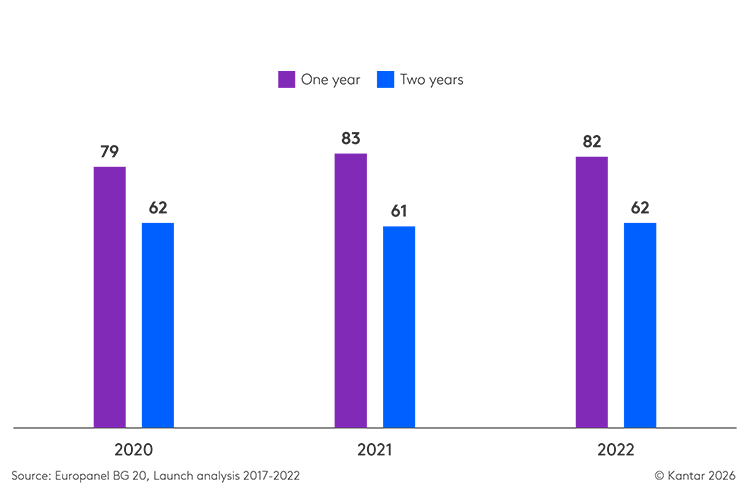
Almost 40% of new launches are dead or declining by the end of Year 2
Then there's the brutal physics of getting to market. Europanel analysis of branded launches between 2017 and 2023 found that a typical launch reached just two of the top nine retailers, and one in five reached none at all.
Yet the prize for getting it right is enormous. Kantar BrandZ analysis shows that brands seen as both meaningfully different and innovative grew brand value by 54% between 2019 and 2023, against 25% for brands that were meaningfully different alone. That's roughly double the rate.
So innovation is one of the biggest growth levers a business has. It's also one of the riskiest. And we've been flying the most expensive part of it with the instruments switched off.
When we interviewed more than 40 senior insights and marketing leaders about the future of innovation, one theme came through loud and clear: action is the bottleneck. The bottleneck isn't data and it isn't innovation ideas. It's action. Leaders don't need more information arriving late. They need decision intelligence arriving in time to do something about it.
A new way to make better launch decisions
This is why we built LaunchSignals with our partners at Quilt.AI. I want to be specific about what it changes, because broad claims about faster insight can obscure the decisions teams can now make.
1. Get an early read. You can now see how a launch is unfolding in near real time. Emerging digital signals, such as what people are saying, searching, sharing, experiencing, praising and complaining about, show up long before traditional performance measures give you a clear read. LaunchSignals provides you with early launch insights that help teams understand product launch performance while there is still time to investigate what’s happening and decide how to respond.
2. Understand the deeper why. A number tells you something is happening, but it rarely tells you why. LaunchSignals surfaces the forces shaping the result. Is it the product experience, the price, the pack, a competitor's counter-move or a cultural current nobody saw coming? It doesn't replace your survey data. It complements it, giving context and meaning to the numbers you already have.
3. See everything in one view. Today the launch picture is scattered across agencies, dashboards and teams. LaunchSignals connects signals from consumers, competitors, category dynamics and culture in one place from the early weeks after launch. It identifies the right signals for your brand and delivers one cohesive, joined-up view while it still matters.
4. Know when to act. This is the part I'm most excited about. LaunchSignals doesn't just describe what's happening. It flags where attention, intervention or deeper investigation may be needed. That's the difference between a report and a decision.
The right signals enable better launch decisions
Here's what most people miss: launches don't succeed or fail in isolation. They land in a culture, a category and a competitive set that are all moving at the same time.
A signal tells you something is happening. Context helps you decide what to do about it. A surge in mentions could reflect excitement or frustration. Low conversation could point to limited visibility, not a weak proposition. Read either in isolation and you risk solving the wrong problem.
By combining Kantar's innovation and brand-growth expertise with Quilt.AI's digital intelligence and cultural ontology, LaunchSignals reads the cultural context a launch is landing in, moving beyond language interpretation. It shows the fuels driving a launch forward and the frictions holding it back.
That opens up questions we've never been able to answer at speed. Is this launch in tune with culture or working against it? How are competitors' similar launches really performing, and what can we learn from them? Why did an idea take off in one market and stall in another?
LLM visibility belongs in that wider picture too. Understanding brand visibility in AI search starts with practical questions: does your product appear when people ask about the need it addresses? Is its proposition clear?
The goal isn't to react to every signal. The goal is to make better decisions earlier to ensure your launch lands: sharpen the message, investigate an experience barrier, respond to a competitor or gather deeper evidence before changing course.
The right move, for the right reason, while there's still time to make a difference.
What can LaunchSignals do in practice?
Let's look at an example from a well-known rum brand building on category momentum.
We worked with the brand team for the launch with a LaunchEvaluate study. It showed that the new launch's awareness was being overstated by high misattribution: shoppers were confusing the bottle with similar-looking rums, so true awareness was lower than it appeared and had not grown since launch. Acting on this, the brand team switched to high-impact, awareness-raising media and invested in feature and display to make the bottle stand out in store, driving a 30% increase in awareness and a 50% increase in trial and repeat within six months.
However this insight came almost 8 months after launch. Imagine if we could have got to it 5 months earlier...
Looking at the first few months after launch, LaunchSignals was already picking up these early warning signals - highlighting growth was driven by the category rather than specific brand efforts, indicating the need for a more cut through campaign and shelf presence.
LaunchSignals went beyond this, and identified the distinct role the launch was beginning to play in the category: the more playful brand personality occupying a distinct role vs. other rum options, but playing later in the evening.
Most importantly it reinforced confidence in the great taste of the product, pointing to an opportunity to push distribution while leading activation efforts with taste focused messaging and serves where the liquid shines.
The product launch shift: from watching to acting
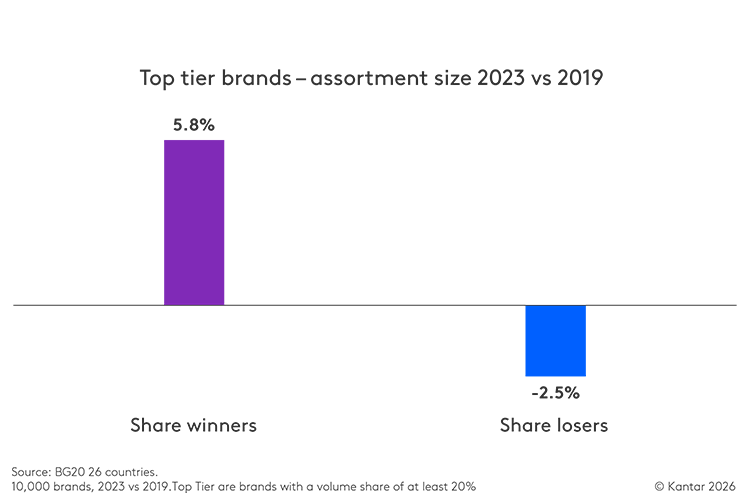
BG20 data shows that the winners aren't the brands launching the most. Large share-winning brands introduced fewer new products, yet those launches grew their assortment by 5.8%, while share losers saw theirs decline by 2.5%. The lesson is to make fewer, stronger bets and, I'd argue, to manage those bets actively once they're in market.
Although winning large brands have introduced fewer new products, these have been incremental
That's the real shift. For the first time, launch teams can move from watching a launch to acting on it while it's still taking shape. They can fix the message, back the channel that's working and get ahead of a complaint before it becomes the story. If the signals point the other way, they can make the hard call early, before more budget follows a struggling idea.
The learning doesn't stop there. Every launch you read this way becomes intelligence for the next one. Launch stops being the finish line and becomes the start of the next decision.
So here's my challenge
Think about your last big launch. When did you really know how it was going? What would you have done differently if you'd known six weeks earlier?
If the honest answer makes you a little uncomfortable, you're not alone, and you no longer have to accept it.
We would love to talk to you about LaunchSignals and show you the signals and decisions you’ve been missing.
The next launch you manage doesn't have to end in a post-mortem. Click to book a demo with one of our experts.