The gap nobody is naming
Every organisation now has an AI strategy, a roadmap or at least an ambition. Yet meaningful AI-enabled transformation remains elusive.
The reason is not under-investment. It’s under-design. Most organisations have not built the organisational conditions needed to turn AI capabilities into commercial impact. They are deploying 2030 technology inside operating models built for a very different era.
The problem is not AI adoption. It is decision architecture.
What the evidence shows
Kantar's Insights to Intelligence 2030 study drew on interviews with more than 75 CEOs and CMOs, alongside over 4,000 respondents across more than 200 organisations. It found a consistent gap between ambition and operating reality.
Ambition is running ahead of operating reality
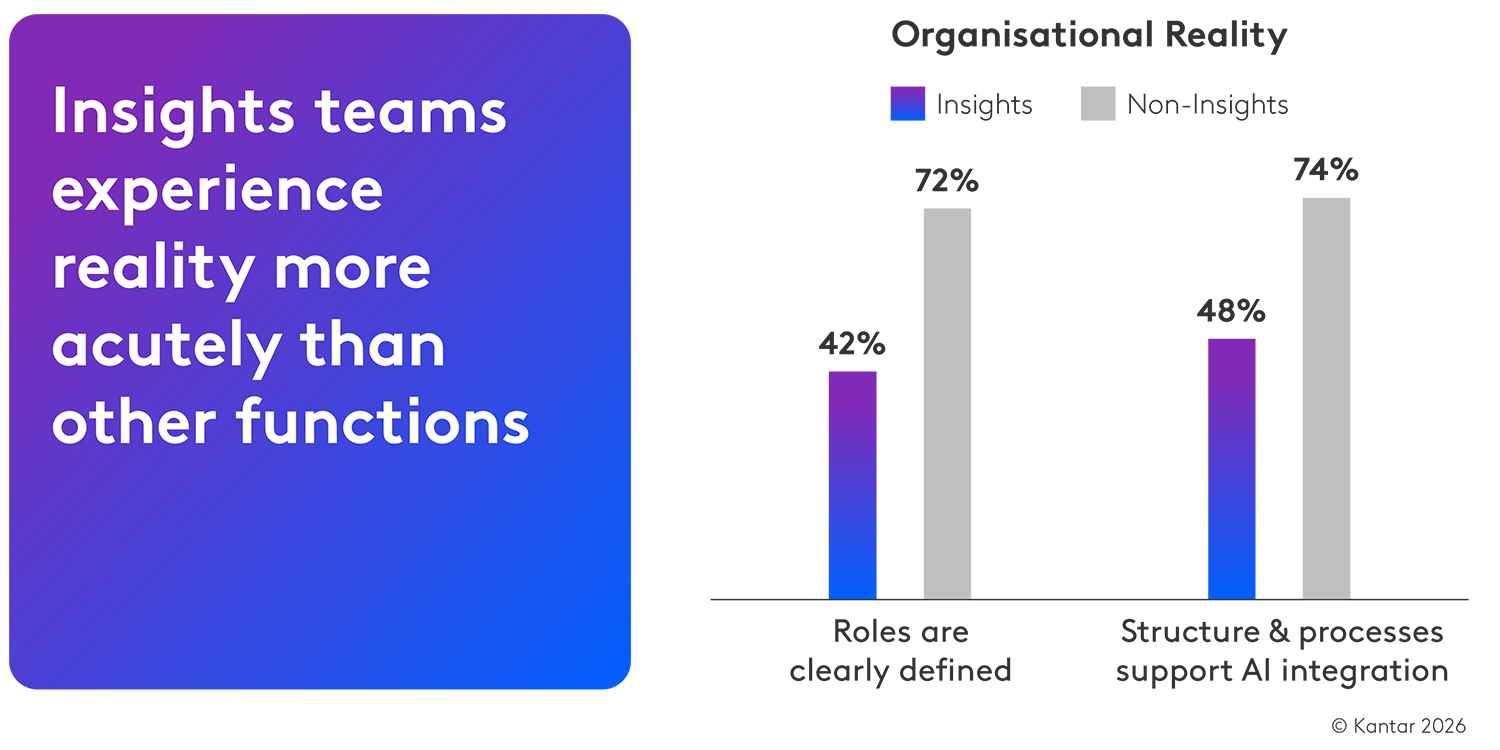
Seven in ten C-suite leaders believe they have a clear AI strategy and vision. Beyond the boardroom only 42% say roles are clearly defined, and only 48% say structures and processes are aligned behind that ambition.
7 in 10
C-suite leaders believe their organisation has clear strategy and vision, ready for a Human + AI future.
Only
42%
say roles are clearly defined.
48%
say structures and processes are aligned.
The people closest to the work see the gap most clearly
Colleagues outside Insights report much greater confidence; 72% clarity and 74% alignment. Among Insights professionals, those figures fall to 42% and 48% respectively. The further you sit from the delivery of intelligence, the healthier the transformation looks.
Why adoption is a false signal
AI usage, prompts, pilots and licences are great lead indicators, but we should not delude ourselves that they are proof of transformation.
Progress so far has concentrated in high-volume, repeatable optimisation decisions, such as content creation and parts of innovation. Yet much of it remains experimentation rather than codified, scalable practice.
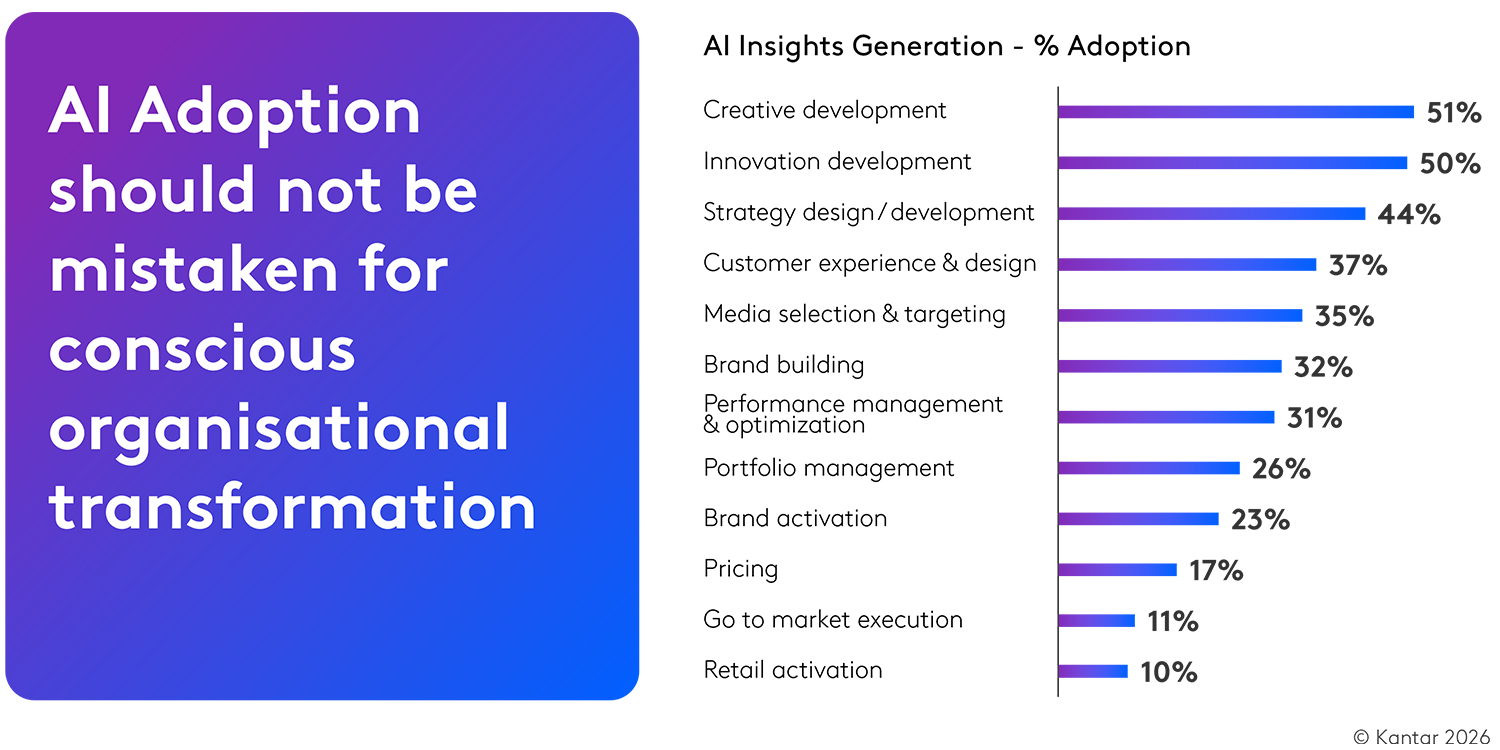
Without conscious choices about where humans lead, where AI should scale and where the handoffs sit, your operating model will be decided by accident, driven by whichever tools and agents happen to be adopted.
A model for future readiness
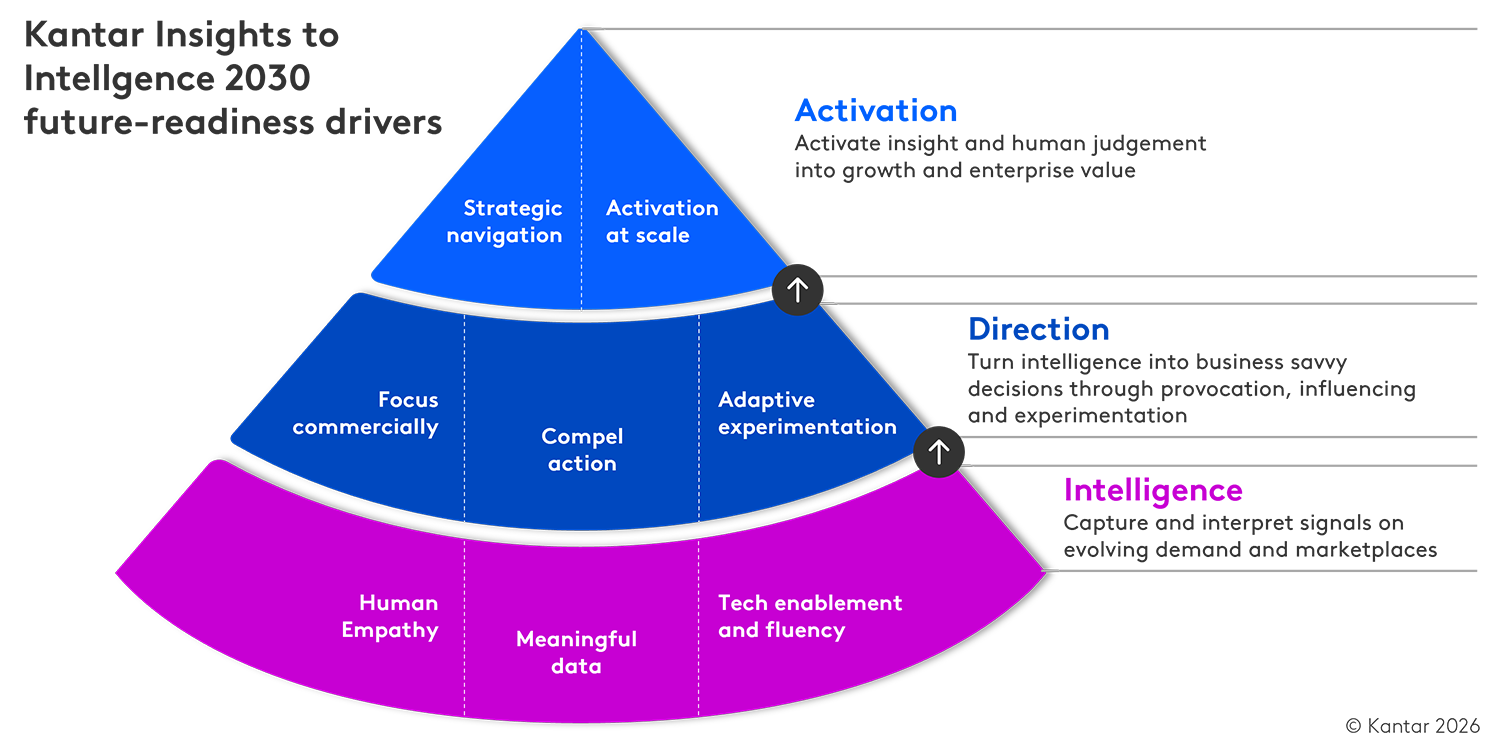
The Insights to Intelligence 2030 research identifies eight drivers of future readiness, organised in three layers. The alchemy of combining them is critical.
Intelligence: capturing and interpreting signals on evolving demand and marketplaces, built on human empathy, meaningful data and tech fluency.
Direction: turning intelligence into commercially smarter decisions through commercial focus, compelling action and adaptive experimentation.
Activation: converting insight and human judgement into growth and enterprise value through strategic navigation and activation at scale.
Without Intelligence, decisions are disconnected from real change in people and markets. Without Direction, data stays descriptive. Without Activation, insight never scales into workflows or growth. Used as a diagnostic, the model shows where an organisation's intelligence system is strong and where it is constraining growth.
Three priorities for leaders
1. Build the conditions for intelligence to scale
The real constraint is organisation design and change management, not technology. That means clear ownership, defined roles, shared standards and deliberate learning loops, supported by visible change leadership. Technology scales instantly. Trust, capability and behaviour do not.
2. Design around decisions, not insights
Most organisations start by building tools, dashboards, agents and data platforms. Leading organisations prioritise the decisions that are the biggest drivers of growth: where to play, brand positioning, portfolio and pricing, innovation and activation. The question is not where we can use AI, but which decisions matter most and how humans and AI should each contribute to accelerate impact.
3. Move from AI use cases to Human plus AI workflows
The old model ran from research request to analysis to report to recommendation. The future model runs from continuous signals to AI synthesis to human challenge to business decision to learning loop.
Transformation happens when workflows change, with explicit handoffs and guardrails. It does not happen simply because AI adoption rises.
Not every decision needs the same level of human involvement
Triage investment of time and expertise by decision value, frequency and risk:
Business partnering for high-value, ambiguous or reputation-sensitive decisions, where experts interpret, challenge and guide.
Hybrid support for decisions that are repeatable but still consequential, where democratised data and agents widen access while experts steer the highest-impact choices.
Automated intelligence for routine, frequent, low-risk decisions, run through pipelines and agents with minimal human attention beyond anomalies and data stewardship.
The point is not to automate everything. It is to match the model of support to the type of decision, avoiding both AI theatre and human bottlenecks.
From researchers to architects of intelligence
The role of Insights leaders has evolved beyond recognition. Researchers running study to study are set to become extinct, but there is a big, bold opportunity to carve out new roles as architects of intelligence: designers of decision ecosystems, stewards of data quality and judgement and orchestrators of workflows and learning loops across functions.
The provocation and invitation is to stop reacting, stop adapting and start proactively architecting the capabilities marketing and insights will need 18 to 24 months from now.
The objective is not more insight. It is better decisions.
Come and speak to us to understand how to get started, or how to shift gear from adaption to transformation.