

AI helps marketers maximize creative ROI at scale
AI has been the game changer of the decade in advertising and marketing, bringing both excitement and scrutiny. While its ability to streamline processes is widely appreciated, its effectiveness—especially in creative decision-making—has often been questioned. This applies not just to content creation but also to ad testing.
Smart marketers know that the right creative can drive higher ROI, and that validated ad testing provides the insights needed to optimize ads and select the best ones to air. AI-powered ad testing takes this a step further by delivering scale and speed, ensuring all ads can be evaluated, not just hero assets in major markets. But does this come at the cost of accuracy? How can marketers differentiate between AI solutions which are developed quickly based on a few simple rules, or a generic LLM with no understanding of human advertising response, and those which use much more sophisticated models based on extensive training datasets?
Latest comprehensive LINK AI validations prove accuracy without compromising on speed
Kantar’s LINK AI provides a data-driven, efficient way to assess an ad’s potential—in less than 5 minutes. AI prowess is determined by the quality and size of the training dataset it learns from and LINK AI builds on the success of Kantar’s extensively validated LINK database which has over 300k+ tests, and 40M+ human interactions across global markets. As a result, LINK AI delivers predictive insights that closely align with human-based survey results. The latest validations confirm its accuracy across various channels, markets, platforms, categories, and brands.
LINK AI has a rigorous modelling process which leverages the latest machine learning (ML) technologies in neural networks with state-of-the-art embedding methods for feature extraction. Our ML model is an ensemble of algorithms trained to bring together all these features to predict the creative effectiveness KPIs. It is updated regularly, and is proven through extensive use of modern validation methods, including hold-out validation on over 10,000 ads, 10-fold cross validation, and in-field validation for many clients across diverse categories, markets and brands.
LINK AI consistently predicts human ad performance across key metrics. On average more than 7 out of 10 digital video and TV ads achieve comparable ratings within the specific channel and market context where they are assessed. This strong alignment with human-based survey results reinforces its accuracy in assessing creative effectiveness.
Latest LINK AI video validations, Global
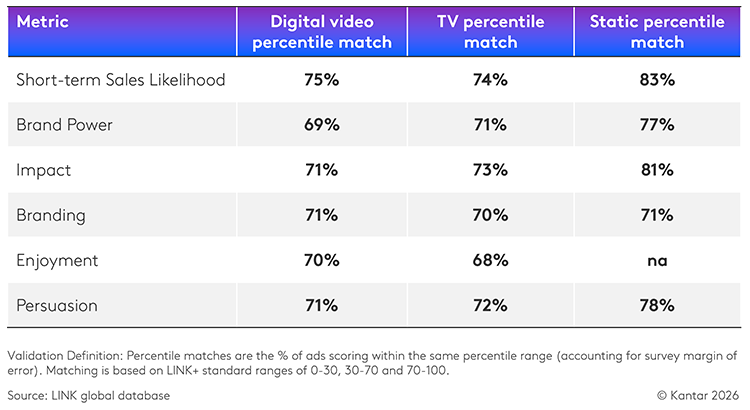
We see similar match rates for static ads (outdoor, print and digital); among different digital platforms including YouTube, Meta and TikTok; and for creator content. We also see similarly strong match rates across a wide variety of very different categories ranging from food & drink, personal care and household products to automotive, retail and services.
This strong alignment also holds true across different markets. In the examples of U.S., Brazil, and Germany, around 3 in 4 TV ads achieve comparable survey and LINK AI results across key metrics. This global reliability reinforces its value as a powerful, scalable tool for marketers looking to optimize creative effectiveness with confidence.
Latest LINK AI validations, percentile match per market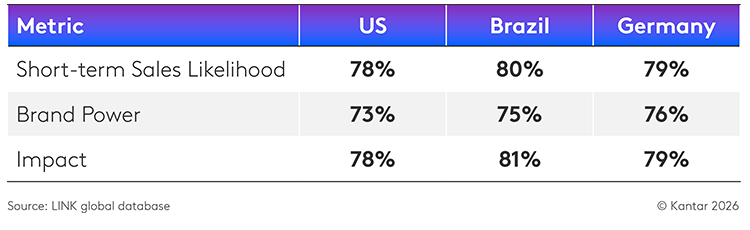
Beyond LINK AI validations with LINK survey results, some clients also validate LINK AI through to other external effectiveness indicators. One major FMCG client validated 8,500 digital ads vs sales effectiveness for 3 brands in 4 markets across 3 platforms using MMM (Market Mix Modelling). They found that the top third of ads on LINK AI delivered 37% more incremental platform-driven sales than the bottom third of ads. Individual LINK AI metrics can also predict specific consumer behaviors including attention, skip rates and in-market engagement.
Additionally, publishers such as Snap and agencies such as Whalar have seen excellent relationships with in-market campaign brand lift. Whalar’s validation work for creator content showed that key metrics of Awareness, Consideration, and Purchase Intent were within +/- 2 percentage points of results from traditional brand lift studies. Kantar’s own in-market validation based on over 400 ads and 35 LIFT+ campaigns has shown that strong creative (as measured by LINK AI) drives 50% incremental brand growth in multi-media effectiveness studies.
Balancing stability with sensitivity
While headline validation statistics are important, they are only one aspect to consider when evaluating a predictive model. In day-to-day use, the actionability of a creative effectiveness model is defined more by how well it helps an individual advertiser identify the ads which will work best for their brand. A “safe” model will predict cautiously based on what it has seen before. A more sensitive model is better able to discriminate between similar ads to provide more useful insights.
Over the past year, we significantly enhanced this aspect of the LINK AI model, enabling a typical client to see twice the range between stronger and weaker ads for an individual brand in a specific market and channel.
Some common AI validation pitfalls
While most marketers are increasingly comfortable with the idea that AI creative predictions work well at scale, they become less certain whether it will work for their ad, in their market, in their unique situation. We sometimes see advertisers attempting to “validate” AI creative testing by running a handful of ads through AI testing and attempting to compare those scores with survey or in-market results. This is invariably a mistake. Attention in these exercises tends to focus disproportionately on the two ads out of 10 which match less well, or the two metrics which match less well among this small sample of executions, rather than celebrating the 8 successes. We often see people failing to account for the margin of error, which is present in any form of survey testing, treating the survey results as gospel, rather the representative estimate they really are.
All of this does AI testing a disservice. AI predictions do not think in the same way humans do. While they can be trained on the outcomes from human observations and opinions, they are arriving at their effectiveness conclusions and predictions in a fundamentally different way. When there are differences between AI predictions and human survey sampling, this does not mean the AI predictions are automatically “wrong”. Far more likely is that the ultimate truth about the strength of the execution lies somewhere between the two data points.
AI can understand and assess creativity
Can AI decode human creativity and predict its impact accurately? The answer is, yes it can. And the best way to demonstrate this is via real-world examples.
As part of our ongoing partnership with Effie Awards Europe, we ran 153 recent winning entrants through LINK AI. Even within this set of successful ads, LINK AI was clearly able to differentiate between good and great ads. The gold winners scored 9 percentile points higher than silver and bronze winners on our key branded Impact metric.
One of the recent standout examples is “Nothing Cracks Like Magnum.” This campaign centers on the brand’s distinctive asset that symbolizes its premium nature, the unmistakable cracking sound of its thick chocolate coating. It scores highly (top 20th percentile) via LINK AI in branding and in its ability to drive long-term impact for the brand. The sound is the hero of the campaign videos, causing cats to jump and pigeons to fly away en masse. As one Effie juror noted, even in static or audio-off formats, the visual was so vivid you could almost hear the cracking in your head. LINK AI accurately predicted the ad’s border-defying success, which you can read more about in detail in Kantar and Effie Europe’s booklet, along with other award-winning creativity cases.
LINK AI helps advertisers screen and optimize their brand-building content across thousands of assets. Two advertisers applying this exceptionally well are Coca-Cola and L'Oréal who were both recognized for “effectiveness at scale” in the most recent Kantar Advertising Effectiveness Awards. LINK AI has identified standout, award-winning executions for them, ranging from Coke’s simple but powerful “Fe-liz-Na-vi-dad” outdoor ad, to L'Oréal’s Prada Beauty “Gifting” Instagram video and the epic CeraVe “Romeo and Juliette” and “72 and Sunny” TikToks. Further evidence that LINK AI is able to identify and reward ads with drama and humor comes from this highly impactful “Pop Me” YouTube ad for Hero Mighty Patch in France.
If you’re unable to see the video above, please accept our website cookies or visit YouTube to watch the video.
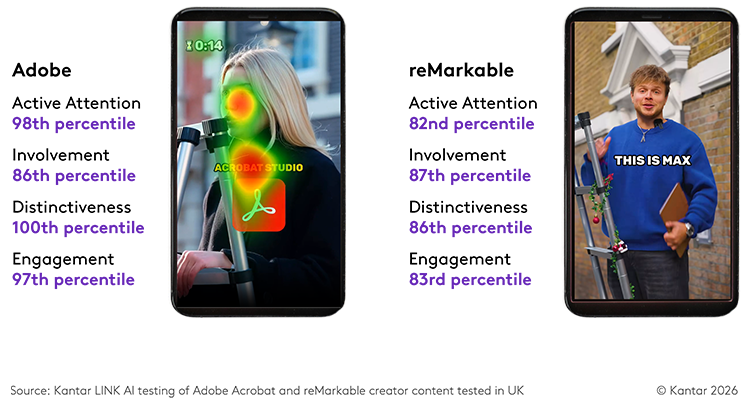
Scale testing is particularly essential for creator content where brands are often managing dozens of assets for a single campaign. Max Klymenko is a creator who is well known for his “Career Ladder” series where he interviews people about their jobs on his ladder. LINK AI is able to demonstrate how his collaborations with brands such as Adobe and reMarkable generate exceptional active attention and engagement thanks to his distinctive approach.
Unlocking new ways to access valuable insights
Marketers now manage more creative assets than ever in their campaigns and AI enables marketers to explore new possibilities to access insights at scale. AI-powered testing provides insight across channels before committing resources. This is especially useful for testing digital across formats which have historically been tested less via survey approaches. The approach is not limited to finished films, LINK AI can also be applied to animatic videos as well as static images.
With LINK AI’s ability to conduct meta-analyses at scale, brands can now also uncover broader creative trends and optimize their strategies more effectively. Creative tags on LINK AI identify key diagnostic features, ranging from tangible elements like 'brand presence' and 'ad pace' to more complex ideas like sustainability, providing powerful insights at scale. This facilitates large-scale meta-analyses that uncover brand-specific creative strategies and platform-specific trends.
Additionally, AI-powered testing makes it possible to assess ad performance across multiple markets, even before translation, helping marketers refine their approach early in the process. Want to know if your North America ad would perform just as well in Brazil or China? LINK AI has you covered with a market transference feature you can deploy before you invest in adaptations or media spend. This approach allows you to use survey testing in lead markets as seed data for even smarter predictions than is possible via standalone AI testing.
Harness the power of AI-powered testing to make smarter choices
AI-powered ad testing is transforming the way marketers make creative decisions, delivering speed, scale, and accuracy without compromising on effectiveness. LINK AI’s latest validations prove its reliability across key metrics, markets, categories and channels, helping brands optimize their ads with confidence. From predicting ad performance to enabling large-scale meta-analyses and market transference, AI is unlocking smarter, data-driven choices for advertisers. Discover how you can unleash the power of LINK AI for your brand, whatever channel, market or category.
Note: This August 2026 article is an update of an article originally published in March 2025