


01 | Australia is no longer an isolated case
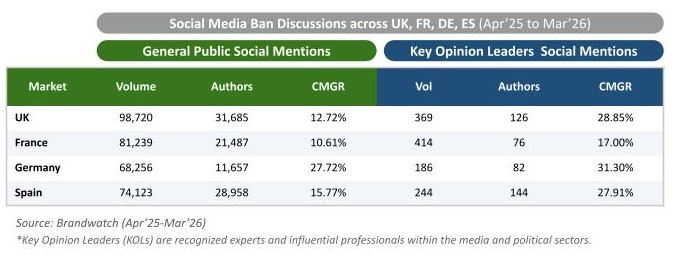
From April 2025 to March 2026, conversation around banning children from social media accelerated sharply across the UK, France, Germany, and Spain, propelled by Australia’s world-first law and growing EU momentum.
Australia is the anchor reference point, surfacing in 8.6% of public posts and recurring through expert shorthand like “world-first” and “Australia-style.” This momentum is spreading across Europe, with the European Parliament advocating stricter limits on minors’ access and the European Commission advancing EU-wide age verification systems.
The UK drives the largest public conversation, with nearly 99K mentions across 31K+ authors. Influenced by Australia's world-first ban and prominent advocates such as Jonathan Haidt, discussion has evolved beyond the case for intervention and towards questions of implementation, age verification and the broader implications for platforms and digital rights.
Germany is the fastest-growing and most polarised market, posting the highest growth in both public (27.72% CMGR) and KOL (31.30% CMGR) discussion: a smaller but highly engaged audience where opposition mobilises early, and the most civil-liberties-driven debate, centred on surveillance, censorship, and fears of a "digital ID by the back door."
For marketers, the key takeaway is that a social media ban is no longer just a compliance issue but a cultural one.
02 | The backlash isn’t against safety - it’s against surveillance
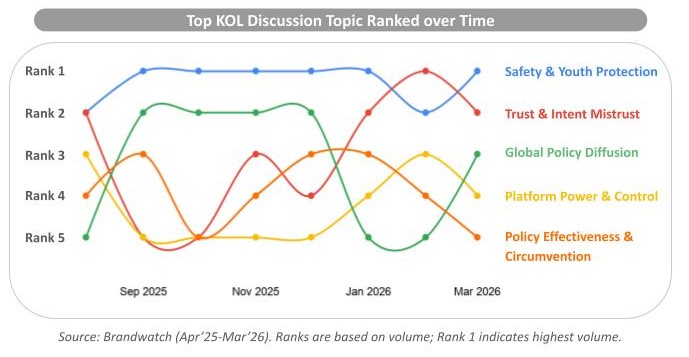
Child safety is the foundation of the debate, ranking #1 theme for both KOL and the public. However, the debate is increasingly shaped by concerns over what these policies could enable beyond child protection.
Among Key Opinion Leaders, discussion around Trust & Intent Mistrust rose sharply by Q1 ’26, reflecting growing scepticism toward the motivations and long-term implications behind the social media ban.
• “Although presented as child safety measures, they in fact usher in an era of mass surveillance, censorship, and erosion of freedom of expression.”
KOL Expert · Pablo Malo · Evolutionary Psychiatrist · ESP · Mar 2026
• “A real-name policy by the back door. They’re not concerned about young people. They’re concerned about control, surveillance, and censorship.”
KOL Expert · Zara Riffler · DEU · Feb 2026
Now, debate is no longer solely about protecting minors online, but about how these measures could expand systems of monitoring, identity verification, and control. As youth regulation expands globally, brands operating within digital ecosystems will need to manage not only regulatory compliance but also public perception around privacy, autonomy, and trust.
03 | Platforms are already being cast into roles
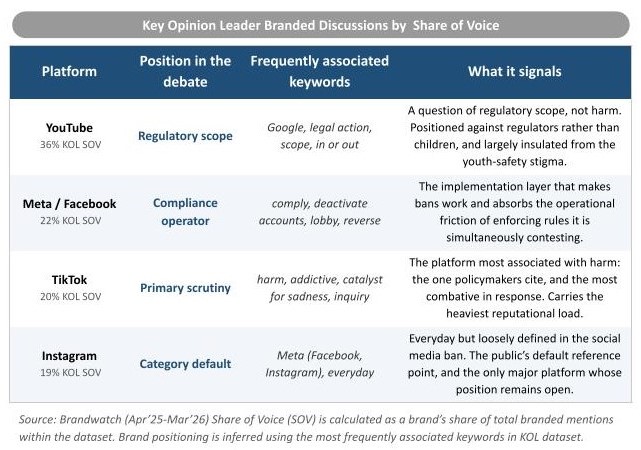
In a debate about trust, platforms are being actively cast into roles. They are defined not just by frequency of mention, but by the keyword associations they appear alongside. These roles are becoming sticky: once a platform is typecast, new narratives tend to reinforce the same position.
Based on the table below, two implications follow. First, these roles are assigned rather than chosen, and they are hardening quickly, limiting each platform’s ability to reposition. Second, no platform currently plays a positive role. The narrative is defined in opposition to regulators, enforcement, or child safety concerns. There is no credible platform associated with healthy youth engagement yet. This absence of a constructive, future-facing role represents a clear white space in the debate.
04 | The white space for brands
The current debate creates a clear whitespace for brands, where shifting platform roles and rising regulatory pressure open up opportunities to define more trusted and constructive positions.
1.Claim the empty narrative: No platform yet owns a positive narrative, allowing category leaders to shape what responsible, age-appropriate engagement looks like.
2. Mind the surveillance backlash: growing concerns around broader digital identity tracking, especially in Germany and the UK, mean age-gating and first-party data strategies risk triggering a surveillance backlash.
3. Make trust a product feature, not a compliance requirement: Categories most exposed to youth audiences, such as gaming, beauty, fashion, QSR, streaming, and edtech, can differentiate through transparent data use, anti-addictive design, and wellbeing-led marketing.
Brands that act early in these whitespace areas will be best positioned to shape expectations, build trust, and establish leadership as the regulatory and cultural narrative continues to harden.
THE BOTTOM LINE
In youth wellbeing, surveillance remains a key point of tension. Platforms are being cast into defined roles, but future winners will be brands that act early in the whitespace: building trust by design, addressing surveillance concerns, and delivering real value to both young users and parents.