

Meanwhile, ChatGPT’s browsing and Shopify integrations are turning chats into guided shopping moments. As AI agents grow more capable of advising, filtering and recommending, they are starting to shape decisions upstream of traditional search and social platforms. This means that GenAI is not only generating content, but also becoming a channel for influence, discovery and advertising.
While the tools continue to evolve, our underlying data reveals how people perceive GenAI. Kantar’s Media Reactions report reveals growing optimism among consumers, with some caveats.
Growing positivity, unevenly distributed
Sentiment toward Generative AI is rising overall. Over half of consumers (56%) now say they feel positive toward GenAI, up from 47% the previous year. Marketers show much stronger enthusiasm, with 75% feeling positive, up from 68%. This widening gap reflects direct experience. Marketers can see what GenAI enables inside workflows, while consumers primarily encounter finished outputs.Regional variation adds further nuance. Consumers in Africa and the Middle East show the highest positivity at 74%. In contrast, Europe sits at 49% and Asia Pacific at 47%. These differences matter for global brands that need to balance operational efficiency with local audience expectations.
Consumer positivity towards possibilities of GenAI across regions
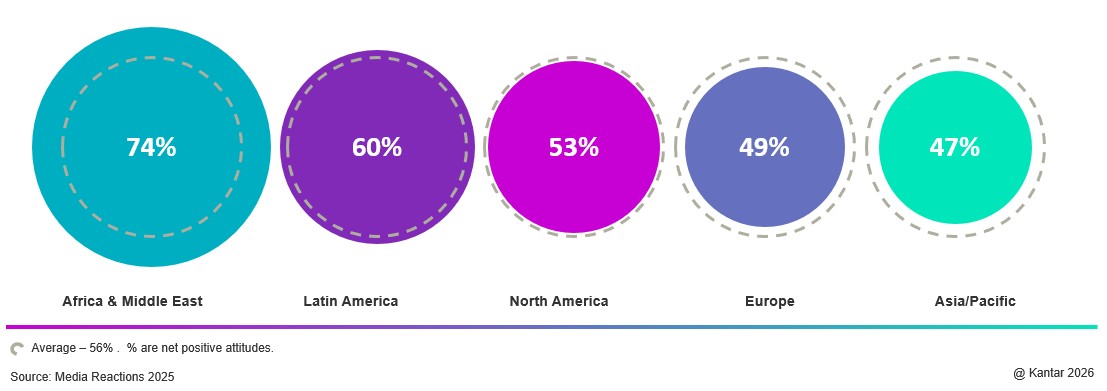
Our data shows that enthusiasm and concern coexist. Over half of consumers in North America and Europe distrust ads that are AI-generated, and consumers in Africa and the Middle East, although excited, are distrustful (46%.)
Demographic splits follow a predictable pattern. Younger adults are most enthusiastic, with Gen Z and Gen Y showing excitement levels above 55%. Boomers’ excitement is significantly lower at 21%. Like regional preferences, distrust still permeates all generations (43-51%). This duality signals an appetite for innovation paired with a desire for reassurance.
Consumers and marketers don’t experience GenAI in the same way
The divide between consumers and marketers becomes clearer when looking at their feelings on advertising. Only 51% of consumers say they feel excited about AI in ads, compared with 63% of marketers. This means half of global consumers remain unconvinced about AI’s role in the messages they receive.Consumer hesitation is closely tied to authenticity expectations. Only 48% say they like seeing AI‑generated images in ads, and 57% express concern about fake or misleading AI‑generated advertising. These concerns reflect broader anxieties about misinformation and blurred lines between real and synthetic content.
A split view on GenAI
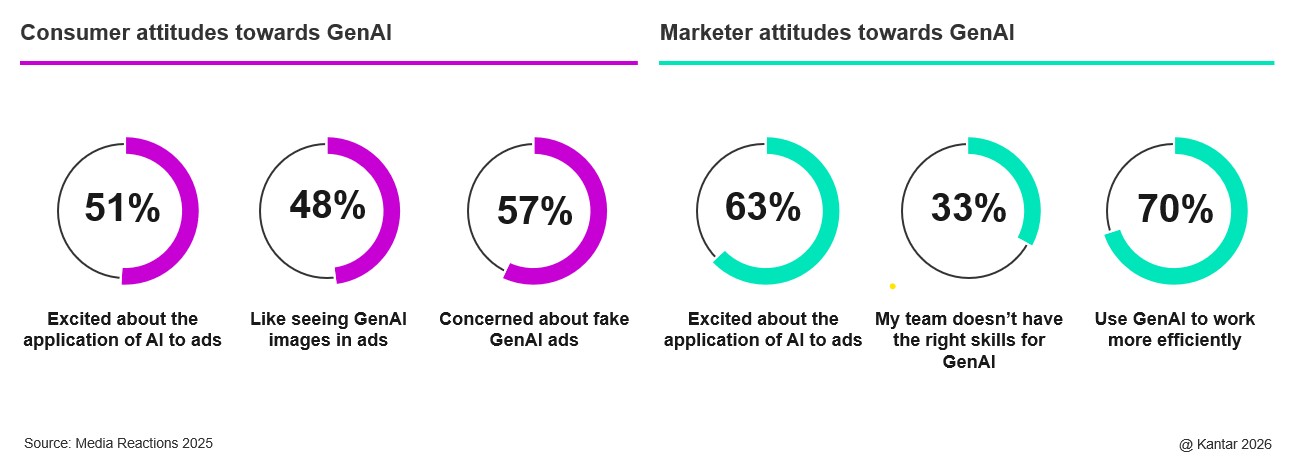
Marketers, in contrast, see both efficiency and strategic value. Almost three quarters of marketers (70%) already use GenAI to work more efficiently, and only 33% believe their teams lack the skills to use it. Many now view GenAI as embedded throughout the creative process: inspiring ideas, scaling variations, localising content and supporting measurement. The entire ad does not need to be generated by AI for AI to play a meaningful role. And GenAI's role in media planning and buying is accelerating in areas such as programmatic buying and audience targeting - it is now supporting campaigns throughout their life cycle, becoming an integral part of marketing workflows.
As Aarti Bhaskaran, Global Head of Research & Insights, Snap Inc, explains “It’s really about using AI to make our workflow more efficient without losing the human touch, so we have more headspace to focus on strategy and bigger ideas.” This difference in perspective is shaping how quickly GenAI adoption accelerates inside marketing organisations, and not employing it means being left behind.
Why the consumer awareness gap matters
Consumers mainly notice exposure to GenAI through high‑profile moments, such as viral AI videos, digital avatars or speculative news stories. The quieter uses of AI, including content versioning, language adaptation, asset resizing and iterative testing, rarely attract attention. This creates a visibility gap. Marketers see AI as a practical assistant. Consumers see AI as a creative engine that may or may not feel trustworthy.
This mismatch explains why consumer excitement lags behind marketer enthusiasm. The lag is not driven by rejection of technology, but by lack of context: if for example if people are unsure what is real in an ad, or unsure about where GenAI has been used.
Some platforms and creative ecosystems are already responding by emphasising transparency, provenance or commercially safe development. Adobe, for example, frames Firefly around responsible training, IP protection and automatically applied content credentials for generated assets, positioning these features as essential to brand safety.
Clearer communication about how GenAI is used in media will become part of effective brand building.. Advertisers need to test and learn at scale. How Gen AI is best deployed in ads should be a test and learn approach.. According to our LINK database, when it comes to overall impact, GenAI-created ads score slightly lower (54% average percentile) than non-AI ads (65% average percentile.) Some Gen AI ads are strong performers, but there are also weak ones, and on average, many marketers aren’t yet at the stage where they can take full advantage of the technology.
In this fast-moving environment, your brand is what will set you apart, so care needs to be taken for its protection, as well as its growth. Any use of GenAI needs to be in service of setting your brand apart as meaningful and different, not for risky short-term gains.
The road ahead: education, transparency and thoughtful integration
The data points to a clear conclusion: there is a GenAI education job to do in the media space. This does not mean explaining every model or method. It means providing clarity where it matters. Brands can help audiences understand why GenAI is used, what guardrails are in place and how quality and integrity are protected.Future opportunities will depend on the capabilities of emerging tools, and on whether audiences feel confident engaging with AI‑enabled content. Transparency will play an important role across all regions and demographics.
At the same time, organisations can continue to deepen their understanding of both the creative potential and the risks of GenAI. Experimentation is expanding, and the industry is moving from pilots to widespread adoption. As Kevin Babcock, Head of Creative Partnerships, Google, says, "Gone are the days when a single 15-second ad can fuel an effective campaign. AI for scale helps us version, adapt and deliver the right asset to the right user at the right moment"
The momentum is undeniable. The imperative now is to ensure that GenAI adoption evolves in a way that builds trust, elevates creativity and strengthens the value exchange between brands and consumers.
Discover more insights to drive smarter media planning, here: Kantar Media Reactions 2025: Your guide to the media landscape
Get in touch to discuss how Kantar’s media experts can support your brand’s media strategy and click to learn more about our Media Effectiveness solutions
Source: Media Reactions 2025.