
As intent becomes easier to express, search stops returning links and starts returning answers: comparisons, reasons, and ‘best for’ recommendations. The choice still belongs to people, but it increasingly begins inside a machine‑curated shortlist.
Our data shows this clearly: brands are now competing to enter consideration. In travel, more than 80% of Google searches now trigger an AI‑generated overview, and 82% of ChatGPT users say they use the chatbot for travel conversations.
In the machine world, the picture is starkly different. Brand websites account for roughly 50% of citations in travel answers; Reddit about 4%; mainstream social less than 1%. Reviews, forums, Q&A sites and authoritative aggregators all contribute. Rather than being shaped by a single dominant channel, AI recommendations are assembled from many different digital sources and brands have to ensure the same story comes through clearly across them all.
This is where signal intelligence becomes the new marketing muscle. Humans respond to stories, emotion, imagery and cultural cues. Machines respond to patterns, consistency and corroborated facts. Humans can forgive contradictions, machines treat contradiction as risk. If our social creative earns a million hearts but never gets reframed as structured, citable evidence on our site or in credible third-party sources, the model may not “see” it at all. Conversely, if our website is a well-structured, up-to-date, verifiable library of reviews and neutral citations, the model lifts us into view. Signal intelligence is the discipline of shaping those machine read signals without losing the human truth that gives a brand its meaning.
What’s striking is how quickly AI has become influential. Combine AI chat with AI overviews and you already get ~4.6% of predisposition in travel, a top-five touchpoint for something that barely existed two years ago. The implication isn’t of course to chase algorithms, but to make sure your strongest human-world signals translate into the machine world: a website the model trusts, reviews that reinforce your claims, and distinctive proof points it can recognise instantly.
1. Treat your website as a source of truth, not a shop window. Build it to be machine‑readable as well as human‑useful: clear Q&As, schema‑marked FAQs, structured specs, and verifiable proof points that models can cite with confidence.
2. Convert social energy into machine‑read signals. Social still builds feeling, but unless the story is captured in citable formats (credible articles, customer stories, expert commentary), models won’t pick it up consistently.
3. Make your Meaningful Difference unmistakable and consistently signalled. You may not “own” a territory, but you can lead on a clear, valued advantage. When that advantage is expressed the same way across sources, it’s far more likely to surface in generative answers. Ambiguity gets averaged out.
4. Treat AI recommendation as a new shelf and a new first impression. The summary, descriptors and supporting facts become the first‑impression narrative people encounter. Your job is to ensure the model introduces the brand with your strongest, most differentiated truth.
5. Monitor the machine’s perception as closely as brand health. Just as Share of Search became an early indicator of brand salience, Share of Responses is emerging as a meaningful proxy for brand equity in AI-led discovery, reflecting how clearly a brand is understood, differentiated and trusted by machines.
What has changed is the route those choices now take. AI agents increasingly shape the first impression, quietly filtering which brands are seen, compared and trusted.
The brands that win are those whose emotional narrative and factual footprint tell the same story everywhere a human looks and everywhere a model reads. GEO, as the bridge between what people feel and what machines interpret, is rapidly becoming one of the most important disciplines in modern marketing.
Curious what this shift means in practice? Watch our expert roundtable video on-demand here. You'll hear from Kantar's experts from across disciplines and markets to help you ground strategy in data and validate your thinking with those closest to the evidence.
Our data shows this clearly: brands are now competing to enter consideration. In travel, more than 80% of Google searches now trigger an AI‑generated overview, and 82% of ChatGPT users say they use the chatbot for travel conversations.
Congratulations SEO, you’ve had twins
The EO (Engine Optimisation) family is larger and more influential than ever. Classic SEO (Search Engine Optimisation) still matters, but it no longer covers the field. AEO (Answer Engine Optimisation) focuses on being quotable by search AIs. GEO (Generative Engine Optimisation) shapes how your brand is interpreted and recommended across AI systems. With that shift, SEO, long treated as technical hygiene rather than strategy, now sits firmly at the centre of growth and value creation.Two worlds, one consumer
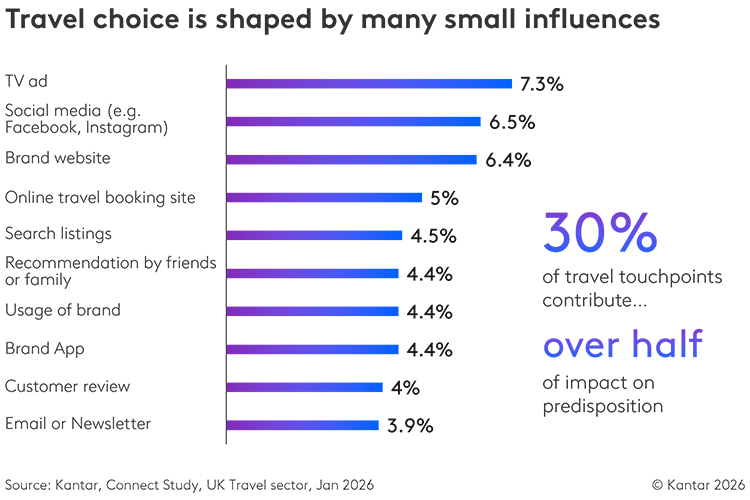
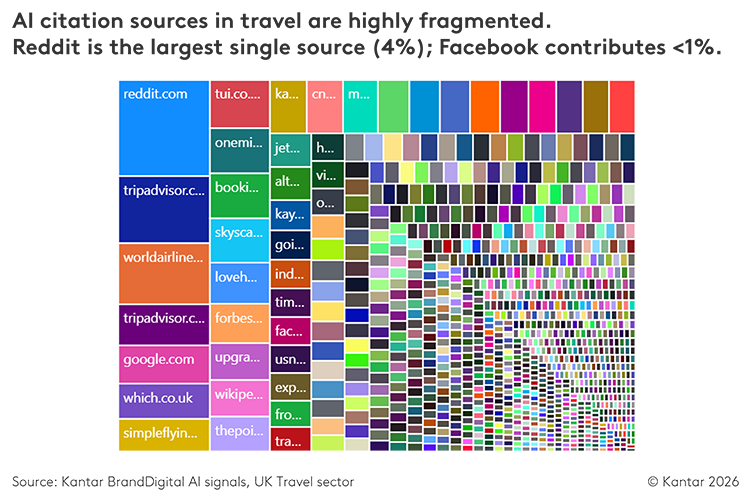
There is a tension I see in the numbers. In the human world, predisposition is built by “lots of littles”. Take travel for example, TV advertising is still the single largest driver of brand equity (7.3%), closely followed by social media (6.5%) and brand websites (6.4%). Word of mouth, usage, OTAs, reviews, apps and email stack meaningful, albeit smaller, increments of influence. It is a mosaic, and that mosaic works: big, broad reach media sparks salience, owned experiences educate, social inspires, delivery and reviews reinforce belief.In the machine world, the picture is starkly different. Brand websites account for roughly 50% of citations in travel answers; Reddit about 4%; mainstream social less than 1%. Reviews, forums, Q&A sites and authoritative aggregators all contribute. Rather than being shaped by a single dominant channel, AI recommendations are assembled from many different digital sources and brands have to ensure the same story comes through clearly across them all.
This is where signal intelligence becomes the new marketing muscle. Humans respond to stories, emotion, imagery and cultural cues. Machines respond to patterns, consistency and corroborated facts. Humans can forgive contradictions, machines treat contradiction as risk. If our social creative earns a million hearts but never gets reframed as structured, citable evidence on our site or in credible third-party sources, the model may not “see” it at all. Conversely, if our website is a well-structured, up-to-date, verifiable library of reviews and neutral citations, the model lifts us into view. Signal intelligence is the discipline of shaping those machine read signals without losing the human truth that gives a brand its meaning.
Big brands can still miss the shortlist
Big brands may be mentioned more often, but that doesn’t guarantee a top spot in an AI’s recommendations. In our comparisons, the heavyweights often land midtable on sentiment: salience gets you noticed, but it’s Meaningful Difference that earns you the praise. If a brand isn’t clearly known for something specific and valued, the model defaults to neutral descriptions or adds caveats.What’s striking is how quickly AI has become influential. Combine AI chat with AI overviews and you already get ~4.6% of predisposition in travel, a top-five touchpoint for something that barely existed two years ago. The implication isn’t of course to chase algorithms, but to make sure your strongest human-world signals translate into the machine world: a website the model trusts, reviews that reinforce your claims, and distinctive proof points it can recognise instantly.
Signal architect? Yes, that too
Peter Markey, Chief Marketing Officer at Cancer Research UK, once said that the modern CMO is “part artist, part scientist, part champion for marketing within a business.” To that list, we now add part signal architect, someone who ensures the brand is understood emotionally by people and interpreted structurally by machines. Here are five habits that compound over time:1. Treat your website as a source of truth, not a shop window. Build it to be machine‑readable as well as human‑useful: clear Q&As, schema‑marked FAQs, structured specs, and verifiable proof points that models can cite with confidence.
2. Convert social energy into machine‑read signals. Social still builds feeling, but unless the story is captured in citable formats (credible articles, customer stories, expert commentary), models won’t pick it up consistently.
3. Make your Meaningful Difference unmistakable and consistently signalled. You may not “own” a territory, but you can lead on a clear, valued advantage. When that advantage is expressed the same way across sources, it’s far more likely to surface in generative answers. Ambiguity gets averaged out.
4. Treat AI recommendation as a new shelf and a new first impression. The summary, descriptors and supporting facts become the first‑impression narrative people encounter. Your job is to ensure the model introduces the brand with your strongest, most differentiated truth.
5. Monitor the machine’s perception as closely as brand health. Just as Share of Search became an early indicator of brand salience, Share of Responses is emerging as a meaningful proxy for brand equity in AI-led discovery, reflecting how clearly a brand is understood, differentiated and trusted by machines.
Becoming the brand worth recommending
People remain the protagonists. Their perceptions are shaped by the stories they hear, the reviews they read, and the recommendations they trust.What has changed is the route those choices now take. AI agents increasingly shape the first impression, quietly filtering which brands are seen, compared and trusted.
The brands that win are those whose emotional narrative and factual footprint tell the same story everywhere a human looks and everywhere a model reads. GEO, as the bridge between what people feel and what machines interpret, is rapidly becoming one of the most important disciplines in modern marketing.
Curious what this shift means in practice? Watch our expert roundtable video on-demand here. You'll hear from Kantar's experts from across disciplines and markets to help you ground strategy in data and validate your thinking with those closest to the evidence.