In today’s hyperconnected world, global brands face a dilemma: the more they scale, the more they must localise. Consumers expect brands to speak their language, literally and culturally, while still delivering the consistency and trust that come with global recognition.
This tension is especially sharp in travel, where expectations shift dramatically across borders. Booking.com, once a functional Dutch platform, has evolved into a global brand that feels local in over 40 languages. How? By embedding local relevance into its brand DNA without diluting its core identity.
“In pursuing our mission to make it easier for everyone to experience the world, we’ve become more than just a platform — we’ve become a trusted travel enabler that people rely on.”
In this article, we explore how brands can strike that balance, using Booking.com as an example and Kantar’s Blueprint for Brand Growth as a strategic lens.
Why local relevance is a growth lever
Global consistency builds trust. But local relevance builds preference, and preference drives growth.
Kantar’s BrandZ data shows that brands perceived as both Meaningful and Different grow faster in value than those that are only one or neither. And in many markets, ‘Meaningful’ increasingly means locally resonant. Consumers want brands that understand their culture, reflect their values, and speak to their specific needs.
Smart brands know that relevance doesn’t mean reinvention. The most effective ones tailor their presence to local contexts, without fragmenting their identity. It’s not about creating 50 different brands for 50 markets. It’s about flexing within a strong, recognisable frame. This approach is increasingly seen as a growth accelerator, especially when it’s backed by behavioural insight and a clear understanding of what makes a brand both consistent and connected. Coca-Cola offers a great example. Its brand identity stays consistent globally, but it adapts messaging to local cultures, like using regional languages or tapping into local traditions. These subtle shifts make the brand feel familiar and relevant everywhere, without losing its core.
Booking.com does this by empowering regional teams to adapt campaigns, content, and even UX to local expectations. From humour in ads to the way travel options are presented, the brand optimises for cultural nuance while staying unmistakably Booking.com.
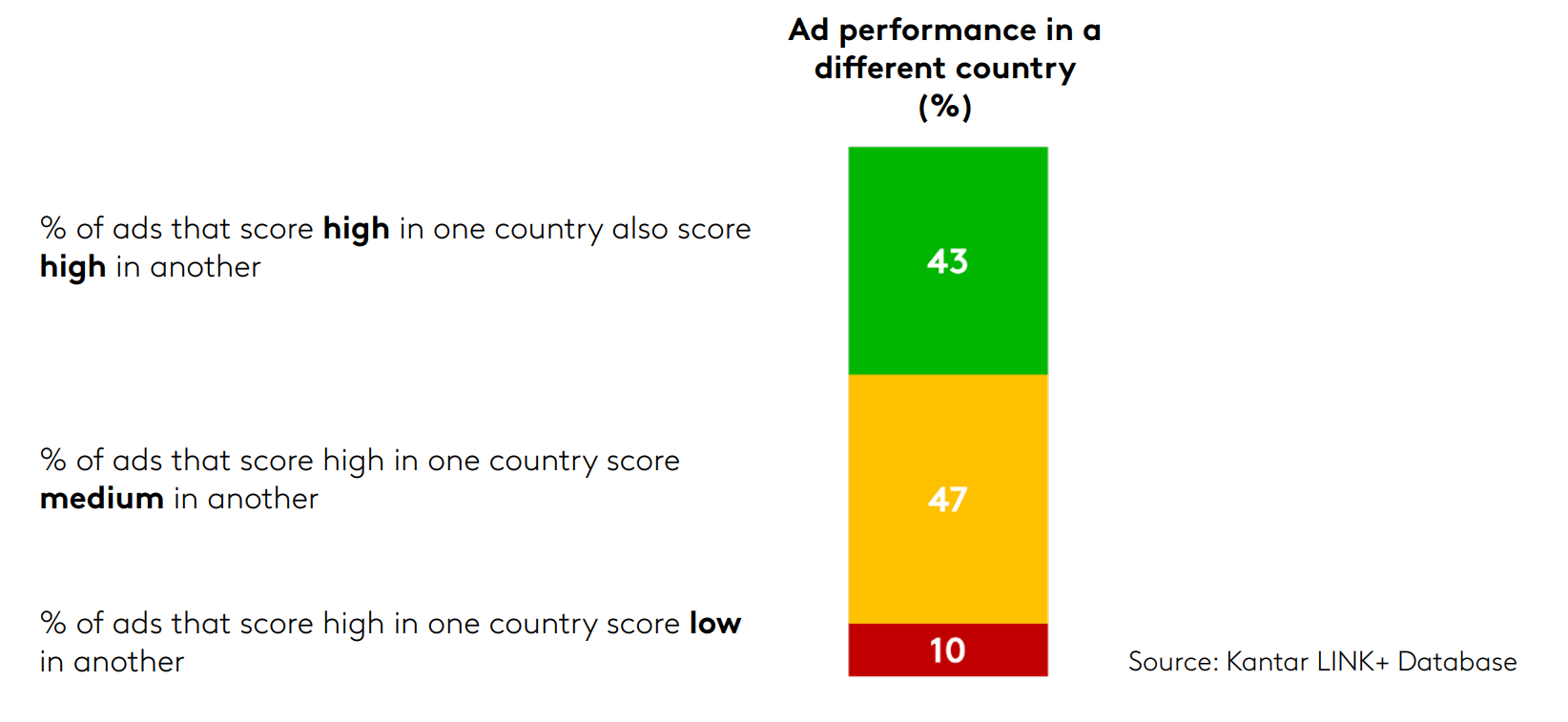
A strong ad in one country can perform average or below average in another.
Booking.com in practice: Local by design
Booking.com’s transformation from a functional booking engine to a globally trusted travel brand is rooted in its ability to act local while thinking global.
“We aim to show up consistently for our travellers around the world but always in a way that feels locally relevant. That means tailoring our campaigns to reflect the needs, languages, and cultures of each market, while staying true to the core of our brand.”
The company’s localisation strategy goes beyond translation. It involves deep cultural adaptation. Adjusting tone, imagery, humour, and even product features to fit local expectations. For example, the annual Travel Predictions research helps Booking.com understand emerging behaviours and preferences across markets, ensuring that campaigns and product features speak directly to what matters most locally.
This is a key part of how Booking.com remains relevant and trusted worldwide. More broadly, insights and learnings from local markets are systematically shared with global teams, ensuring that best practices and new findings from one region can inform and enhance the brand’s global strategy, a best practice highlighted in Kantar’s Blueprint for Brand Growth.
This collaborative approach means regional teams play a central role. They collaborate with global brand leads to ensure that creative assets resonate locally while maintaining brand consistency. This includes adapting the Booking.yeah campaign to reflect local travel habits, humour, and emotional triggers. The result? A brand that feels familiar and relevant whether you’re booking a weekend in Amsterdam or a honeymoon in Kyoto.
Three takeaways for marketers
Balancing global consistency with local relevance isn’t easy, but it’s essential. Here are three practical actions marketers can take:
1. Empower local teams: Give regional teams the autonomy to adapt global assets. They’re closest to the consumer and best positioned to spot cultural nuances. Provide clear brand guidelines but allow flexibility in execution.
2. Build flexible brand codes: Establish strong brand codes, logo, tone, visual identity, that anchor your brand globally. But design them to be modular, so they can flex across markets without losing coherence.
3. Use data to stay connected: Invest in local insights. Use research, social listening, and performance data to understand what matters in each market. Then feed those insights into creative, media, and product decisions.
Winning with a local voice
The future belongs to brands that can be both globally consistent and locally resonant. Booking.com shows that it’s possible to scale trust while staying culturally relevant, by embedding localisation into every layer of the brand experience.
“While our product is grounded in utility, focused on making things easier, faster, and more reliable, it’s through that simplicity and consistency that we create a deeper emotional connection with travellers.”
For marketers, the challenge is clear: embrace the ‘glocal’ mindset. One that blends the reach and recognition of a global brand with the nuance and empathy of local execution. This means building systems that empower teams, encourage cultural fluency, and stay connected to what matters in each market.
Kantar’s Blueprint for Brand Growth can support this process, by helping brands stay Meaningfully Different and behaviourally connected, wherever they show up.
This article is part of an exclusive series inspired by an interview with Ben Harrel, Managing Director US at Booking.com. Want to explore the full story? Download your free booklet here.