
As we count down to the launch of Kantar BrandZ’s Most Valuable Global Brands on the 14th May, one question moves back to the top of the C‑suite agenda: how well do we understand the true value of a brand as a driver of enterprise growth?
For years, CMOs have known that brands matter. What has changed is not the importance of brand, but the environment in which it must now prove and defend its value. Economic volatility, rising scrutiny on marketing spend, and increasingly complex decision systems driven by technology and AI have intensified a simple but uncomfortable question in boardrooms around the world: how exactly does brand drive enterprise value?
Brand valuation is the answer most CMOs have been waiting for, even if it has not always been framed that way.
At its best, brand valuation is not a score, a ranking, or a marketing trophy. It is a financial lens that allows marketing leaders to translate brand strength into decision‑ready intelligence about growth, resilience, and shareholder value. It gives CMOs a way to connect what people think and feel about a brand to what ultimately matters to CEOs, CFOs, and investors.
In an era where clarity is the scarcest resource, brand valuation brings discipline, credibility and confidence to marketing leadership.
Against this backdrop, brand has not weakened. It has become more valuable and exposed.
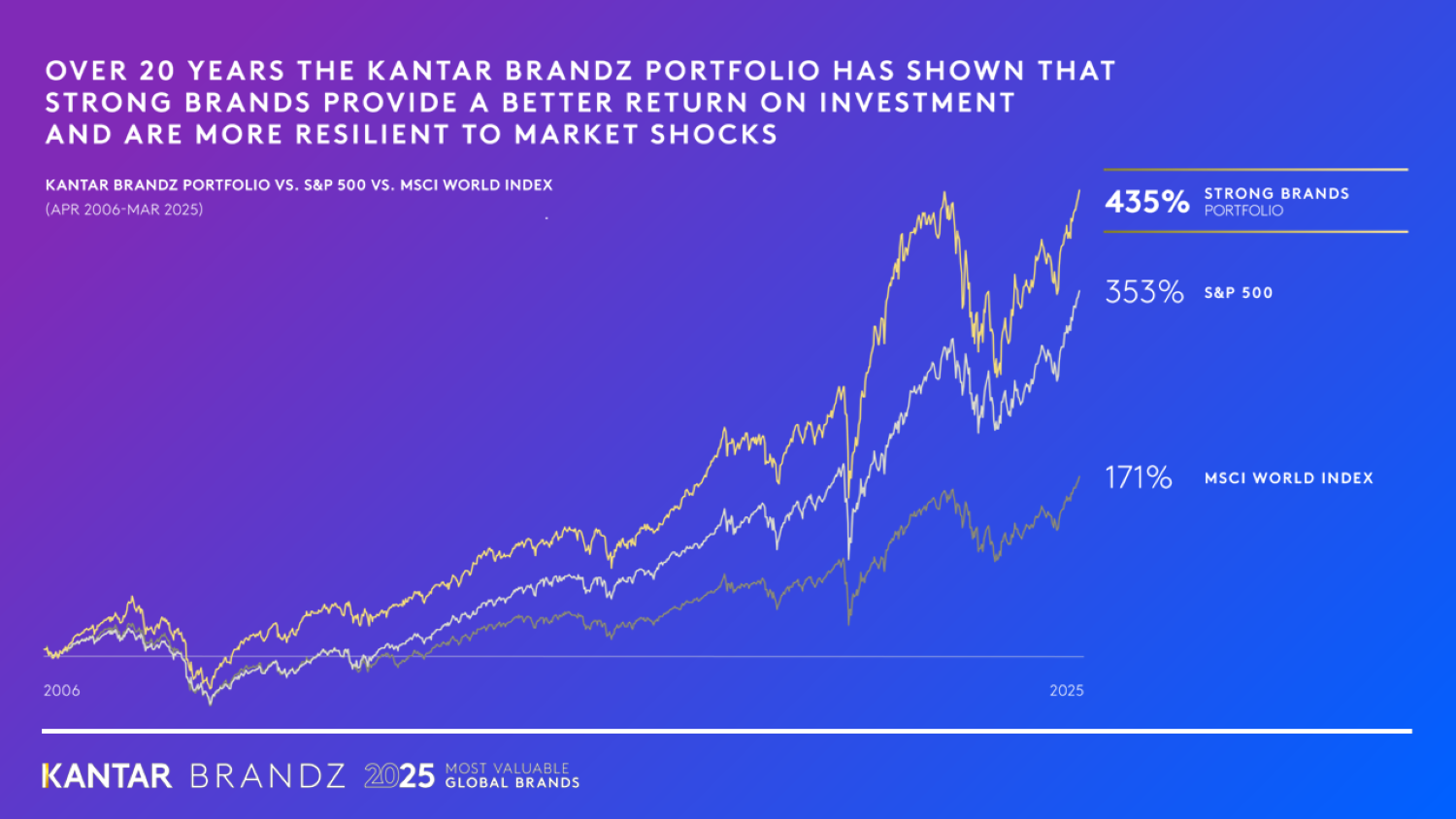
Long term Kantar BrandZ analysis shows that strong brands consistently outperform financial markets over time. They are more resilient during downturns and better positioned to accelerate when conditions improve. This is not because brand is a communications asset. It is because brand shapes demand, pricing power, and future cash flows.
For many organisations, brand accounts for roughly a third of total business value, and for the strongest brands, it can account for more than half. Very few assets have that level of influence, yet brand is often the least understood at board level.
Brand valuation changes that dynamic. It reframes brand from a marketing outcome into a strategic asset that can be measured, managed and grown.
For years, CMOs have known that brands matter. What has changed is not the importance of brand, but the environment in which it must now prove and defend its value. Economic volatility, rising scrutiny on marketing spend, and increasingly complex decision systems driven by technology and AI have intensified a simple but uncomfortable question in boardrooms around the world: how exactly does brand drive enterprise value?
Brand valuation is the answer most CMOs have been waiting for, even if it has not always been framed that way.
At its best, brand valuation is not a score, a ranking, or a marketing trophy. It is a financial lens that allows marketing leaders to translate brand strength into decision‑ready intelligence about growth, resilience, and shareholder value. It gives CMOs a way to connect what people think and feel about a brand to what ultimately matters to CEOs, CFOs, and investors.
In an era where clarity is the scarcest resource, brand valuation brings discipline, credibility and confidence to marketing leadership.
Why brand valuation matters more now
The past decade has been defined by disruption. Technology has reshaped how people discover, evaluate, and choose brands. AI-driven systems increasingly influence what consumers see, what they consider, and what they buy. At the same time, decision cycles inside organisations have shortened, while the consequences of getting those decisions wrong have grown.Against this backdrop, brand has not weakened. It has become more valuable and exposed.
Long term Kantar BrandZ analysis shows that strong brands consistently outperform financial markets over time. They are more resilient during downturns and better positioned to accelerate when conditions improve. This is not because brand is a communications asset. It is because brand shapes demand, pricing power, and future cash flows.
For many organisations, brand accounts for roughly a third of total business value, and for the strongest brands, it can account for more than half. Very few assets have that level of influence, yet brand is often the least understood at board level.
Brand valuation changes that dynamic. It reframes brand from a marketing outcome into a strategic asset that can be measured, managed and grown.
What makes brand valuation different from brand metrics
CMOs are not short of brand metrics. Awareness, consideration, preference, and NPS are familiar territory. The challenge is not measurement, but application.
Brand valuation sits above individual metrics. It answers a different question: how much financial value does the brand itself create, over and above the business, assets and operations behind it?
The most robust brand valuation approaches combine three elements.
First, a financial foundation that isolates the earnings attributable to intangible assets.
Second, a forward-looking assessment of how strongly the brand is positioned to generate future earnings within its category and competitive context.
Third, a rigorous measure of Brand Contribution, which quantifies the role that consumer perceptions play in driving choice, pricing power, and future demand.
This is where brand valuation becomes particularly powerful for CMOs. It does not just state what a brand is worth. It reveals why it is worth that amount, and which levers matter most for growth.
Insight tells you what happened. Intelligence helps you decide what to do next, with confidence.
Modern CMOs operate in a world of more signals, more decisions and less clarity. Data is abundant, but coherence is rare. Strategy often struggles to keep pace with execution, while scrutiny on investment continues to rise.
Brand valuation plays a critical role in this new intelligence system because it connects signals from consumers, decisions in marketing and finance, and long‑term growth strategy.
As part of strategic intelligence, it connects brand actions to enterprise value. It helps leadership teams understand how changes in brand strength today influence financial outcomes tomorrow. It provides a common language that aligns marketing, finance and strategy around long-term growth.
Crucially, it allows CMOs to move beyond defending budgets towards shaping growth agendas.
Brand valuation does not replace creativity or insight. It elevates them.
By translating brand strength into financial value, it allows CMOs to speak the language of the boardroom without abandoning the fundamentals of brand building. It provides a framework for long term thinking in an environment that often rewards short-term action.
In a world shaped by AI, automation, and accelerating change, the brands that win will be those that combine human understanding with intelligence that drives better decisions. Brand valuation sits at the heart of that system.
For CMOs who want a stronger voice, greater influence, and a more enduring impact on their organisation, brand valuation is no longer optional. It is one of the most powerful tools available to turn brand into a durable source of enterprise value.
These insights will come to life on the 14th May, with the release of the Kantar BrandZ Most Valuable Global Brands Report. The launch will unveil the Global Top 100, alongside 14 global category rankings spanning Alcohol, Apparel, Automotive, Fast Food, Food & Beverages, Financial Services, Business Tech, Consumer Tech, Entertainment & Media, Luxury, Retail, and Telecom Providers. This year also introduces a new Home Care Top 10 and an extended Personal Care Top 20, offering an even sharper view of where brand value is concentrated, where it is shifting and what it takes to build brands that endure.
Register now for the launch event.
Brand valuation sits above individual metrics. It answers a different question: how much financial value does the brand itself create, over and above the business, assets and operations behind it?
The most robust brand valuation approaches combine three elements.
First, a financial foundation that isolates the earnings attributable to intangible assets.
Second, a forward-looking assessment of how strongly the brand is positioned to generate future earnings within its category and competitive context.
Third, a rigorous measure of Brand Contribution, which quantifies the role that consumer perceptions play in driving choice, pricing power, and future demand.
This is where brand valuation becomes particularly powerful for CMOs. It does not just state what a brand is worth. It reveals why it is worth that amount, and which levers matter most for growth.
Brand valuation in an intelligence-led world
One of the most important shifts underway in marketing is the move from insight to intelligence.Insight tells you what happened. Intelligence helps you decide what to do next, with confidence.
Modern CMOs operate in a world of more signals, more decisions and less clarity. Data is abundant, but coherence is rare. Strategy often struggles to keep pace with execution, while scrutiny on investment continues to rise.
Brand valuation plays a critical role in this new intelligence system because it connects signals from consumers, decisions in marketing and finance, and long‑term growth strategy.
As part of strategic intelligence, it connects brand actions to enterprise value. It helps leadership teams understand how changes in brand strength today influence financial outcomes tomorrow. It provides a common language that aligns marketing, finance and strategy around long-term growth.
Crucially, it allows CMOs to move beyond defending budgets towards shaping growth agendas.
How CMOs can use brand valuation in practice
The real value of brand valuation lies in how it is used, not how it is presented.
- For investment decisions: brand valuation enables CMOs to quantify the return on brand building. By linking specific brand associations to financial value, marketing leaders can prioritise the areas with the greatest upside and test scenarios before committing spend.
- For growth strategy: brand valuation supports decisions on pricing, expansion, and innovation. It shows where brand strength can unlock premium pricing, support entry into new markets, or stretch into adjacent categories.
- For portfolio and architecture choices: brand valuation provides an objective way to assess where value is being created or diluted across a brand portfolio. This is particularly valuable in M&A, where decisions are often driven by financial logic alone.
- For investor narratives: brand valuation gives CMOs a role in conversations traditionally owned by finance. Investors increasingly recognise brand as a leading indicator of future performance. When marketing can articulate brand value with credibility, it strengthens the overall equity story of the business.
In each case, brand valuation moves marketing from advocacy to authority.
Bringing marketing closer to the boardroom
The influence of the CMO has always depended on credibility. In the past, that credibility came from creativity, consumer understanding and execution excellence. Today, it also depends on the ability to connect marketing decisions to business outcomes with clarity and rigour.Brand valuation does not replace creativity or insight. It elevates them.
By translating brand strength into financial value, it allows CMOs to speak the language of the boardroom without abandoning the fundamentals of brand building. It provides a framework for long term thinking in an environment that often rewards short-term action.
In a world shaped by AI, automation, and accelerating change, the brands that win will be those that combine human understanding with intelligence that drives better decisions. Brand valuation sits at the heart of that system.
For CMOs who want a stronger voice, greater influence, and a more enduring impact on their organisation, brand valuation is no longer optional. It is one of the most powerful tools available to turn brand into a durable source of enterprise value.
These insights will come to life on the 14th May, with the release of the Kantar BrandZ Most Valuable Global Brands Report. The launch will unveil the Global Top 100, alongside 14 global category rankings spanning Alcohol, Apparel, Automotive, Fast Food, Food & Beverages, Financial Services, Business Tech, Consumer Tech, Entertainment & Media, Luxury, Retail, and Telecom Providers. This year also introduces a new Home Care Top 10 and an extended Personal Care Top 20, offering an even sharper view of where brand value is concentrated, where it is shifting and what it takes to build brands that endure.
Register now for the launch event.