
The utilities category is not where marketers might expect to find a disruptive superstar, even in the United Kingdom where the market allows some competition. Nor is it a category where brands excel at forging positive connections with consumers. In fact, according to the UK’s Institute of Customer Service, this category is the lowest ranking for customer satisfaction.
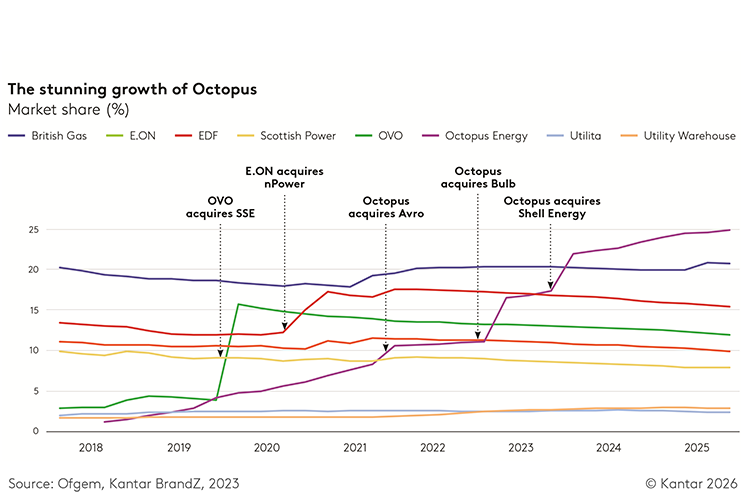
Over the last six years, UK-based energy supplier Octopus has achieved a scale of growth not previously seen in any sector. Its market share for electricity supply has gone from single digits in 2020 to the number one spot in 2023, when it surpassed the category’s long-time leader: British Gas.
Some growth has come from the acquisition of competitors. It took on 5% market share from Bulb in 2022 following its collapse, and 4.2% from Shell Energy in 2023 following its divestment. But since the end of 2021, Octopus has gained a whopping 5% market share with around 2.6 million customers from organic growth. Plus, it has successfully scaled its customer service to support this influx.
So, how did a brand emerge from a category with the lowest consumer satisfaction to become the UK’s poster child for disruption through exceptional experiences?
Encounters, predispositions, actions
Choosing an energy provider is not like grabbing a yoghurt off the supermarket shelf. When customers switch supplier - whether for a better deal or because they’ve had a bad experience elsewhere - it’s a high consideration activity.
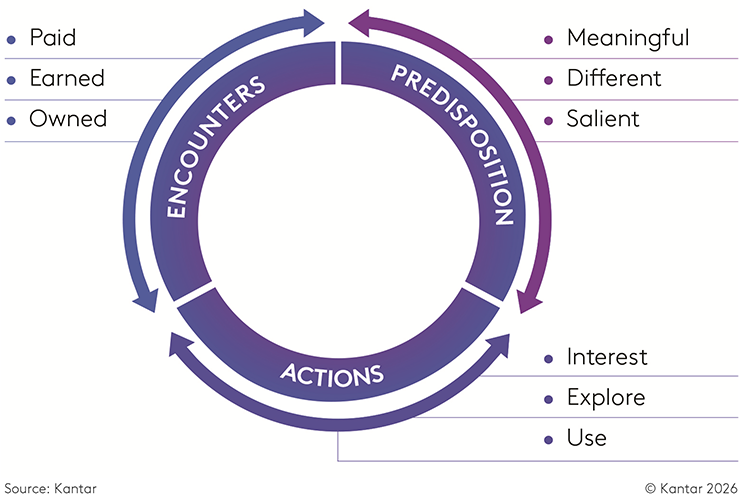
Brand choice is influenced by lots of big and small encounters: marketing exposures, customer experiences, noise in the news, gripes from friends and family, independent reviews, and so on. These paid, owned, and earned encounters influence the customer’s brand perceptions and future behaviour - they may be more likely to notice the supplier, or explore its website. This creates another encounter that further builds predisposition towards the brand; customers may perceive it as delivering on their needs (Meaningful), standing out from other brands (Different) or coming to mind quickly (Salient).
The experiences in brand-owned channels then become the primary source of brand perception, but all other marketing exposures and encounters continue to influence familiarity and feelings towards the brand.
I heard it through the power line
The scale of positive word of mouth – the extent to which consumers feel they have ‘heard good things’ about a brand – is a powerful signal that indicates how effectively the experience travels beyond existing customers.
Kantar BrandZ data shows that by 2025, nearly 40% of consumers said they had ‘heard good things’ about Octopus. In contrast, 31% of consumers said they had heard good things about British Gas, despite British Gas having 10 percentage points more consumer awareness than Octopus. Scale without the sizzle, so to speak.
The genuine substance behind the Octopus experience sets the brand apart and contributes to its growing recognition. Octopus topped the Which? UK consumer associations rankings for best energy suppliers in 2026. The brand has been a Which? Recommended Provider for nine years running.
Octopus amplifies this effect by sharing these accolades on its website and billboards. Its radio advertisements feature real customers celebrating how Octopus’s call centre staff went the extra mile to resolve their issue.
Design for Difference
‘We focused on differentiating ourselves through service, and we work relentlessly to build the technology and culture to deliver that’, says Greg Jackson, Octopus CEO.
A simple belief has shaped Octopus from the start: ‘Octopus Energy exists to provide cheaper, greener energy, with exceptional customer service for people in the UK’, says Rebecca Dibb-Simkin, Chief Product and Marketing Officer. On this basis it has designed a differentiated experience that feels uniquely Octopus, with a disruptive streak. Their website showcases awards and customer reviews, but also the cost of energy wasted in the UK from switching off wind turbines due to grid inefficiency. Customers can join the Octopus Fan Club to be rewarded with cheaper energy when their local wind turbine is spinning, turning green energy into something with tangible customer benefit.
Octopus has designed for Difference by making everyday interactions more enjoyable. For example, customers not using automated smart meters are more likely to suffer nasty bill surprises. To avoid this, customers are encouraged to submit meter readings themselves, but uptake is often low. Octopus nudges customers into their spidery cupboards with the ‘Wheel of Fortune’, an app feature to win a prize every time they submit a reading. It is a clever way to reduce unpleasant bill shocks, leading to fewer calls to Octopus’s contact centres. Everyone benefits.
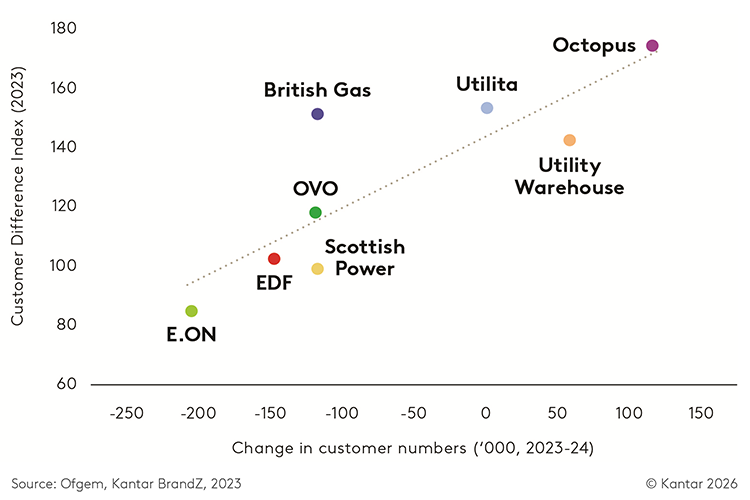
The fastest-growing brands demonstrate their distinctiveness everywhere, including the design of their products and service. It goes beyond appearance. Customers should feel the overall experience is unlike any other supplier. Kantar’s Customer Difference Index for UK utilities shows how Octopus leads the way, and how its performance predicts growth.
Customer Difference explains 72% of organic growth
The double drag
Customers experiencing poor service are more likely to leave. But the drag is doubled when poor service becomes associated with the brand and reduces the likelihood that new customers join. People heed warnings from friends and family, and when researching a new supplier online, they are put off brands that score badly on industry rankings.
This reputational drag has real commercial consequences. The Customer Difference chart shows that from Q3 2023 to Q3 2025, OVO, E.ON, EDF and Scottish Power declined in market share by one percentage point on average. This equated to an estimated annual loss of around 286,000 households and £14.3m in potential profit.
Most customers switching away from these brands went to Octopus, helping Octopus add 1.1 million new households between 2023 and 2025 alone.
When downward-trending word of mouth exceeds the levels expected for a brand of its size, this is a vital signal for the CEO. This signal intelligence keeps a pulse on how perceptions are changing, before they show up in churn figures.
Growing from experience
Customer experience should be evaluated by its contribution to growth, acquisition, as well as retention.
Strong service creates advocacy. Advocacy builds predisposition in others. Predisposition influences switching behaviour. And these switching behaviours grow market share. The spectacular rise of Octopus shows what can happen when these elements reinforce each other.
In any category, brands must create experiences that people remember and share. They must ensure those stories travel. And they must gather the right signals to understand if these experiences make the brand seem different from everyone else.
Discover how the most valuable brands win in Kantar BrandZ’s 2026 Most Valuable Global Brands report now available at www.kantar.com/campaigns/brandz/global