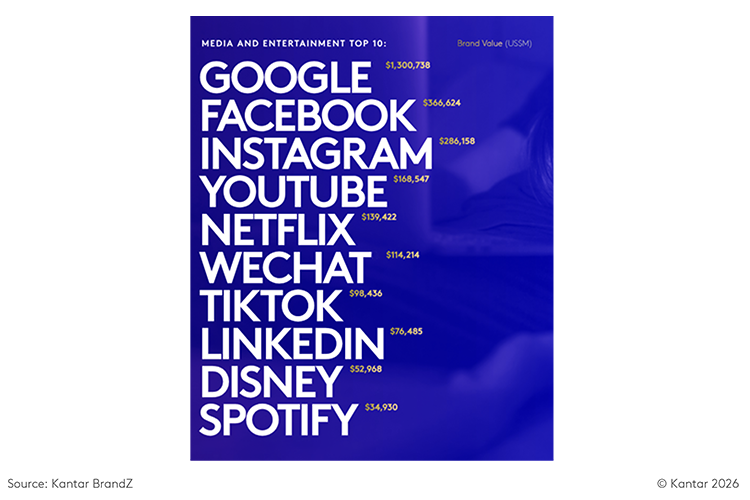
The acceleration of AI is driving one of the most profound shifts in brand value ever observed. The threshold for entry into the Kantar BrandZ Global Top 100 has reached its highest level ever. At the same time, AI innovation has also driven a 40% year-on-year rise in the BrandZ Media and Entertainment Top 10 category ranking.
At first glance, the category’s strong performance may seem surprising. After all, top legacy media brands have not always thrived in times of massive technological disruption. Think of how the internet decimated print media, or how streaming video stole viewers from broadcast television.
What makes this current moment so different is the adaptability of today's leading media brands. The category's biggest players are also some of its biggest AI innovators. For instance, consider the parent companies behind Google and YouTube (Alphabet), Facebook and Instagram (Meta), and WeChat (Tencent). Far from burying their heads in the sand, they’re all funding some of the world's biggest AI research labs.
Meanwhile, brands like Douyin (TikTok), LinkedIn, and Spotify may not be building full-fledged LLMs like their competitors. Yet they’re still investing heavily in AI, developing new tools for content discovery, ecommerce integration, and talent management.
The upside of all these innovations is greater user engagement and increased market consolidation.
For all that today's media and entertainment landscape offers a wealth of choices, it also resembles the 'old days' when consumers stuck to a limited number of available channels.
Except now, it's consumers who are doing the (self-)limiting. Despite spending more time than ever across streaming video, social platforms, gaming, and music, they’re concentrating that attention on a narrower set of channels, to the benefit of the category's superstars.
What separates these leaders is not technology alone, but intelligence. The strongest media brands use intelligence to know which signals matter, which decisions will strengthen Meaningful Difference, and which strategic bets will create the next space for growth.
Why the most valuable media brands win
In branding terms, what we're really seeing here is the power of Meaningful Difference.
It’s the key to a trillion-dollar question: What makes people click into certain media platforms while ignoring others?
And, just as importantly: What makes people stay within these platforms?
The answer: You have to be Meaningful and Different.
On the one hand, people want a sense of familiarity from a media platform. They want the guarantee of seeing content that they already know and like. That's where being Meaningful comes in. It's about positioning yourself as a brand that meets existing needs.
At the same time, though, people are also hard-wired to crave discovery and newness. And that is the essence of Difference.
The strongest media brands forge mental connections across both dimensions. And then, on a user experience level, they also use AI to optimise their mix of Meaningful and Different, old and new.
Their reward is more frequent choice and strong retention.
Brand spotlight: how YouTube builds Meaningful Difference
Few media brands demonstrate the power of Meaningful Difference better than YouTube, and its recent BrandZ rankings success reflects that strength.
YouTube is currently the 14th most valuable brand in the world, up 12 places from the 2025 Kantar BrandZ Global Top 100 ranking. It also ranks fourth in the Global Media and Entertainment Top 10, up one place year on year.
YouTube's brand value grew 89% between 2025 and 2026, to a new high of $168.5 billion, making it the second-fastest riser. That's ten times its value in 2017, when it first broke into the Top 100.
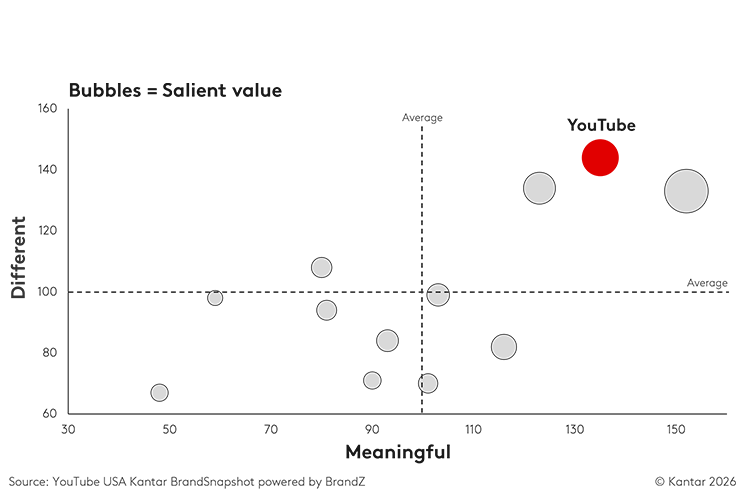
BrandSnapshot, Kantar's free brand equity assessment tool, shows that YouTube maintains a strong brand equity advantage.
And what's behind YouTube's exceptional brand equity performance? In short, Difference is the strongest predictor of exceptional business returns.
Few platforms offer such a wide range of content types, from 45-second Shorts to 4-hour video podcasts. YouTube also excels at straddling the line between the professional (e.g., official sports clips) and the amateur (e.g., Shorts and video podcasts reacting to those clips).
Ultimately, YouTube’s popularity with individual creators really moves the needle. Most platforms can host content from larger corporate studios. But only YouTube has nurtured the rise of creator brands like Mr. Beast and Vlad and Niki.
As creator content continues to overtake traditional TV, YouTube's dominance has expanded far beyond laptops and smartphone screens. By most measures, YouTube is now the most-watched channel on smart TVs worldwide, ahead of Netflix.
Maintaining YouTube’s momentum
It’s easy to take YouTube’s success for granted. After all, YouTube instantly established itself as the internet's favourite video platform since its launch in 2005. Then, after being acquired by Google in 2006, it quickly became the leader in monetising online video.
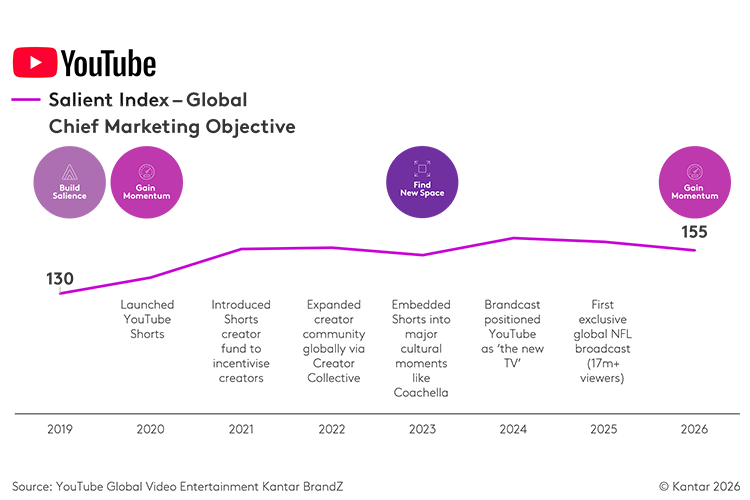
But Kantar BrandZ intelligence shows there have been several moments when YouTube risked losing momentum as the market evolved. One such moment came in 2020, following the rise of TikTok and Instagram Reels.
At that point, and as BrandZ data shows, YouTube's Chief Marketing Objective shifted away from expanding into New Spaces and back towards the more fundamental challenge of Gaining Momentum.
While YouTube's core brand equity remained strong, its Future Power had begun to erode. The brand no longer enjoyed the same level of excess brand equity relative to its competitors, resulting in weaker future choice intent.
In response, YouTube launched Shorts to compete more credibly in short-form video. The brand also invested more in creators across all content formats and lengths. This included establishing a community support network called the Creator Collective, a dedicated Shorts creator fund, and eventually integrating Shorts into the YouTube Partner Program.
The pivot worked, and YouTube soon regained its leading edge. By 2023, YouTube's primary growth challenge shifted back to Finding New Spaces, including video podcasts and streaming bundles.
Now, after several years of strong growth, the wider market is beginning to catch up. Netflix, for instance, is investing heavily in short-form videos and podcasts.
To stay ahead, YouTube is pushing further into major cultural moments, including a deal to become the Oscars' exclusive global broadcaster. Another big priority is innovative AI creator tools for capabilities like video generation and speech dubbing.
The key takeaways for brand growth
The lesson for brand leaders is clear: in a market being reshaped by AI, growth depends on more than brand equity alone. The strongest brands use intelligence to identify disruption early, make sharper decisions, and choose where to innovate next.
That is what YouTube did when short-form video threatened its momentum. And it is what leading media brands continue to do as AI reshapes discovery, creativity, content, and culture.
To understand their position, anticipate change, and identify new growth opportunities, they:
- Use signal intelligence to identify (and co-opt) emerging category disruptions, as well as wobbles in their own brand positioning
- Use decision intelligence to optimise their content and creator mixes for Meaningful Difference
- Use strategic intelligence to determine where and when to focus their innovation efforts, whether reinforcing brand fundamentals or pursuing new growth spaces
The result is that even as AI reshapes the media landscape, the strongest brands stay front of mind and first choice.
Discover more about how the world's most valuable brands win in the 2026 Kantar BrandZ Most Valuable Global Brands Report, and explore the signals, decisions, and strategies behind their success.
Kantar BrandSnapshot is a free interactive tool powered by BrandZ’s wealth of data and validated Meaningful Different and Salient framework. Designed to give you a complete picture of brand equity in competitive context, BrandSnapshot delivers insights on over 15,000 brands in 40+ markets.
Explore BrandSnapshot on Kantar Marketplace for free today.