

Every marketer wants a brand that stands out. Far fewer can say which of their assets are actually making them stand out.
Distinctive brand assets - the logos, colours, characters and signature designs that let a brand look like itself - are hot property right now. Leading commentators agree they are mandatory for growth, whether you lead your category or challenge it. Yet they remain under-used and under-measured.
Distinctiveness is simple in theory. Brutal in practice.
The idea is not complicated. Build a collection of visual and auditory cues that make your brand instantly recognisable. Drawing up a shortlist of these cues is easy. The hard part is consistency. Applying it, year after year, across every market and touchpoint, can be harder than it sounds.
The reason being, boredom is the enemy of consistency. Marketers tire of their creative long before consumers notice it, and fear that sameness will leave the brand struggling to stand out. For heritage brands in need of a refresh, the urge to change things up is stronger still.
The price of getting it wrong is steep. In 2025, Cracker Barrel, the popular US restaurant and general store, invested $700 million in a modernisation effort, including a logo redesign and store remodels that stripped out familiar brand cues. Kantar’s BrandImprint study revealed why every CMO should measure distinctive assets before they modernise them away. The learnings were clear: core customers were alienated, the new logo lost much of the heritage meaning around the brand, resulting in millions of dollars in market value disappearing, and the brand scrambled to backtrack.
The lesson is blunt. Whilst brand familiarity is an asset in the consumer’s mind, changing it carelessly puts at risk what you spent years building. Sameness is not the risk. Being forgettable is.
Meanwhile, the margin for error is shrinking. In a complex, fragmented and AI-mediated environment, brands have milliseconds to create an impact. Consistency is not a creative constraint. It is a core executional requirement.
Know what makes you distinctive, and what doesn’t
Open any brand book and you will find a collection of brand assets. Too often it reads like a design wish list. Not everything we think of as a brand asset is truly distinctive.
This is where proper brand asset measurement helps. It answers the question: What makes an asset strong?
There are three things that contribute to the strength of a brand asset:
- Fame: the percentage of people who correctly link the asset to the brand.
- Distinctiveness: the extent to which people link it to the correct brand, rather than misattributing it to a competitor.
- Intuitiveness: the speed of correct association. In this environment, milliseconds matter.
Kantar’s brand asset measurement tool, BrandImprint, combines the three measures into a single index for every asset.
The evidence is clear: brands with a strong Imprint are 52% more Salient than those with a weaker Imprint. That salience pays off in equity, with 76% higher Demand Power scores for brands with a strong BrandImprint. (These are Kantar ‘s key brand equity measures proven to drive brand growth).
Strong assets also make advertising work harder. Consumers rate the advertising of brands with a strong Imprint as stronger (+138%), and the more ‘strong assets’ a brand has, the stronger that advertising perception becomes.
When it comes to branding, one size fits no one
In the Automotive category, brands compete in an increasingly complex and crowded marketplace making it harder than ever to stand out. As buyers navigate a vast range of vehicle choice, many distinctive brand assets such as logos, fonts, silhouettes, colours, taglines, sounds, and heritage cues are available to marketers. But only a few of these become truly distinctive to create instant recognition, building mental availability for their brand.
To test this, we used Kantar Marketplace to run a BrandImprint study, measuring five US auto brands (Ford, Chevrolet, Toyota, RAM and Mazda), looking at five to seven assets each, including; logos, fonts, model types, celebrities, taglines. The results showed that logos generally performed strongly, and more interestingly, that car models can be brand assets too. However, the opportunity to leverage different types of assets differs by brand.
US automative BrandImprint study – Top 10 Brand asset scores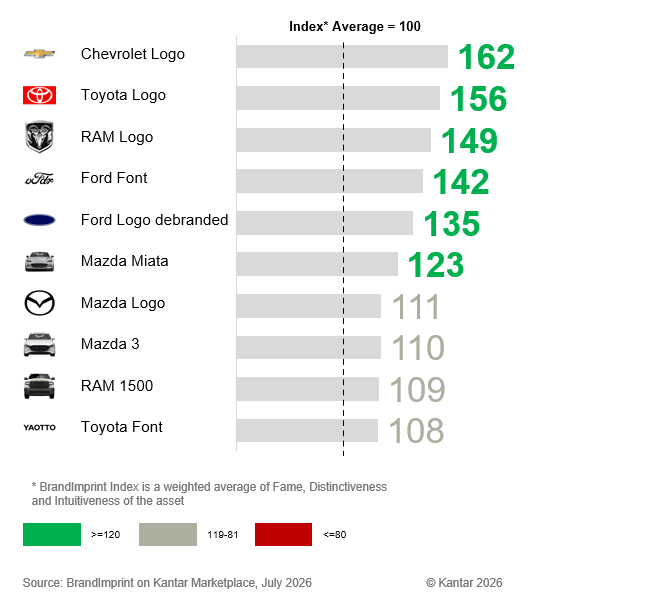
For example, Mazda’s MX5/Miata and Mazda 3 models are powerful cues that can be leveraged in communications to signal the brand instantly. Given that Mazda’s icon and text logos did not score as strongly as their models, they should be paired in ads to strengthen the association. Whereas Ford is the opposite. For Ford, the logo does most of the heavy lifting, while model types and taglines contribute less to the distinctiveness of the brand. For Ford, the answer is to use the logo extensively.
Same category, different playbooks. You cannot know yours without measuring. Measurement tells you which cues are truly ownable, famous and instinctively linked to your brand, and which are easily confused with a competitor’s. That clarity sharpens decisions on branding, communications, product design and sponsorship strategy.
Distinctiveness unlocks creativity
Here is the part that surprises people: distinctive brand assets do not limit creativity. They unlock it.
McDonald’s #RaiseYourArches UK campaign needs no explanation. Show a pair of golden arches and everyone knows whose brand it is. That did not happen by chance. Only focus and consistency builds assets recognisable enough to creatively play with.
McDonald’s #RaiseYourArches UK advertising campaign 
This applies to other creative areas too, such as social media content and pack designs. Wherever branded content is encountered.
Four moves to unleash the power of your distinctiveness
Do you really know what makes your brand distinctive? Do not assume. Start here:
1. Evaluate your assets. See them in a competitive context, using reaction time measurement to reveal which assets are truly intuitive and distinctive. Agile approaches like BrandImprint on Kantar Marketplace can deliver the answer straight to a dashboard, within days.
2. Leverage the most distinctive assets. Clarity unlocks creativity, so make your proven assets work harder. Then invest in building the ones that are not yet distinctive.
3. Be ruthlessly consistent. Use your assets creatively, but with caution. Their true power lies in consistency.
4. Make your assets communicate. Use them to reinforce your brand’s meaning at every opportunity.
Your brand already has a face. The question is whether everyone recognises it in a millisecond.
Click to learn more about on BrandImprint on Kantar Marketplace or get in touch.