
As we count down to the launch of Kantar BrandZ’s Most Valuable Global Brands on the 14th May, one question is returning to the top of the C‑suite agenda: how well do we really understand the value of brand?
Let’s take a closer look at the FIFA World Cup, which every four years, doesn’t just crown a winner; it behaves like one of the world’s most powerful brands.
That might sound like marketing hyperbole, but when we look at the tournament through the lens of brand equity, something very clear emerges: the World Cup isn’t simply watched; it’s anticipated, talked about, organised around, and remembered, long after the final whistle.
It doesn’t just occupy attention, it occupies culture, and crucially, those shifts in attention and cultural relevance show up early in the data, long before they translate into commercial impact. In other words, the FIFA World Cup performs like a brand with extraordinary Meaning, Difference and Salience, the fundamental drivers of long-term brand growth.
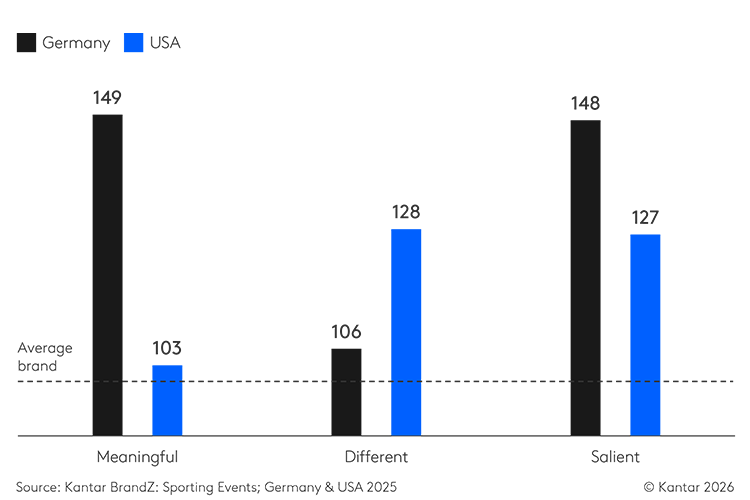
In both Germany and the United States, the tournament scores exceptionally high on Salience. People know it, recognise it, and are aware of when it’s happening. It cuts through, even in the crowded media environment.
But where the two markets diverge is in Meaning.
In Germany, football is deeply embedded in national identity. The World Cup over-indexes on associations like bringing people together, demonstrating the highest skill, and creating collective buzz. It’s not just entertainment, it’s cultural expression, and its Meaning reflects deep emotional and social resonance.
In the US, by contrast, the World Cup is more spectacle than institution. It delivers scale and global attention but lacks the same embedded emotional depth. It is recognised, but not always felt, and that distinction matters. Because, while Salience gets you noticed, Meaning makes you matter. And that distinction is predictive. Markets where Meaning is stronger are ones where future growth is more likely to follow.
As the tournament becomes more embedded in North America, there is a clear opportunity to shift from being something Americans watch, to something they feel ownership of. Germany shows what that looks like when fully realised: a property that is not just viewed but lived.
Let’s take a closer look at the FIFA World Cup, which every four years, doesn’t just crown a winner; it behaves like one of the world’s most powerful brands.
That might sound like marketing hyperbole, but when we look at the tournament through the lens of brand equity, something very clear emerges: the World Cup isn’t simply watched; it’s anticipated, talked about, organised around, and remembered, long after the final whistle.
It doesn’t just occupy attention, it occupies culture, and crucially, those shifts in attention and cultural relevance show up early in the data, long before they translate into commercial impact. In other words, the FIFA World Cup performs like a brand with extraordinary Meaning, Difference and Salience, the fundamental drivers of long-term brand growth.
A global brand with local meaning
The 2026 tournament, hosted across the US, Canada and Mexico, will be the most expansive yet, featuring teams from 48 countries. But Kantar BrandZ data shows something important: while the World Cup is globally recognised, its meaning is not globally uniform.In both Germany and the United States, the tournament scores exceptionally high on Salience. People know it, recognise it, and are aware of when it’s happening. It cuts through, even in the crowded media environment.
But where the two markets diverge is in Meaning.
In Germany, football is deeply embedded in national identity. The World Cup over-indexes on associations like bringing people together, demonstrating the highest skill, and creating collective buzz. It’s not just entertainment, it’s cultural expression, and its Meaning reflects deep emotional and social resonance.
In the US, by contrast, the World Cup is more spectacle than institution. It delivers scale and global attention but lacks the same embedded emotional depth. It is recognised, but not always felt, and that distinction matters. Because, while Salience gets you noticed, Meaning makes you matter. And that distinction is predictive. Markets where Meaning is stronger are ones where future growth is more likely to follow.
As the tournament becomes more embedded in North America, there is a clear opportunity to shift from being something Americans watch, to something they feel ownership of. Germany shows what that looks like when fully realised: a property that is not just viewed but lived.
The power of consistency and renewal
The World Cup has been built over decades with remarkable consistency. Its core assets - the trophy, the tournament format, the iconic team strips of its most successful nations - are instantly recognisable, creating a powerful sense of continuity across generations. Yet each edition also feels new: a different host nation, emerging stars, and fresh narratives reset the story every four years. That balance between consistency and renewal is textbook brand building, reinforcing familiarity while sustaining relevance.
Functionally, the tournament delivers elite competition. Emotionally, it offers something far more powerful: a sense of identity and belonging, layered with nostalgia and shared generational memory. For many fans, the World Cup becomes a timeline of their own lives. The matches matter, of course, but it is the memories around them that endure, and it’s in those memories that the brand’s deepest and most durable strength resides.
For brands, this offers a powerful reminder: Difference is not created by messaging alone. It is shaped by context and by how, when and with whom a brand is experienced. When a brand is embedded in moments that are shared globally and felt simultaneously, its impact is magnified in ways no isolated campaign can achieve.
Together, these forces create a brand that does not simply re‑emerge every four years, but compounds over decades. The World Cup ultimately proves that the brands that read cultural signals early, build Meaning deliberately, and act on those insights decisively, are the ones that transform attention into long‑term growth.
For senior marketers looking to build enduring brands, the implications are clear:
Discover how the world’s most valuable brands win, when the Kantar BrandZ Most Valuable Global Brands Report is revealed on the 14th of May. Register now to join the launch webinar and explore the signals, decisions and strategies accelerating the brand economy.
Functionally, the tournament delivers elite competition. Emotionally, it offers something far more powerful: a sense of identity and belonging, layered with nostalgia and shared generational memory. For many fans, the World Cup becomes a timeline of their own lives. The matches matter, of course, but it is the memories around them that endure, and it’s in those memories that the brand’s deepest and most durable strength resides.
Difference: the power of shared moments
One of the World Cup’s most underappreciated sources of Difference is something few brands can genuinely replicate: global synchronicity. It is one of the rare cultural moments that unfolds in real time, across continents, with billions experiencing the same moments together. Goals, upsets and controversies ripple instantly across cultures, languages and time zones. The experience is shared, communal and time‑bound, and this synchronicity amplifies everything the World Cup stands for: the stakes feel higher, the emotion runs deeper and the memories become collective rather than individual.For brands, this offers a powerful reminder: Difference is not created by messaging alone. It is shaped by context and by how, when and with whom a brand is experienced. When a brand is embedded in moments that are shared globally and felt simultaneously, its impact is magnified in ways no isolated campaign can achieve.
From attention to meaning to growth
What the World Cup demonstrates, consistently and measurably, is how brands convert attention into enduring value. Its global scale builds Salience at a level few platforms can match. Its shared emotional intensity deepens Meaning, turning fleeting moments into powerful associations. Its distinctive, collective experiences sustain Difference in a way that feels both rare and irreplaceable.Together, these forces create a brand that does not simply re‑emerge every four years, but compounds over decades. The World Cup ultimately proves that the brands that read cultural signals early, build Meaning deliberately, and act on those insights decisively, are the ones that transform attention into long‑term growth.
For senior marketers looking to build enduring brands, the implications are clear:
- Build ritual, not just reach: The World Cup is a global ritual: anticipated, shared and repeated. Brands that invest in moments people return to build habit, not just exposure.
- Combine global scale with local meaning: A strong, consistent core makes the World Cup instantly recognisable everywhere, while local context drives emotional resonance. The strongest global brands operate the same way: one idea, flexed locally.
- Design for emotional memory: People remember how it felt, who they were with, and where they were, not just what happened. Brands that create shared experiences, not transactions, build memories that compound over time.
Discover how the world’s most valuable brands win, when the Kantar BrandZ Most Valuable Global Brands Report is revealed on the 14th of May. Register now to join the launch webinar and explore the signals, decisions and strategies accelerating the brand economy.

