
We talk about cultural relevance constantly. But too often we reduce it to tactics: borrowing a trending TikTok audio; slapping a blockbuster IP on a limited-edition line; jumping on a meme. These kinds of tactics may drive fleeting visibility, but they rarely translate into long-term brand impact.
And yet the basic instinct behind these activities is correct. Because the hard truth of our industry is that people don’t inherently care about brands. What they do care deeply about are the many culturally structured forces that shape their lives: communities, shared rituals, art, language, aspiration. And, it’s these cultural signs that brands should keep in mind when trying to connect with people.
From there, the idea should be to embed your brand alongside these elements for the long game. Because not all cultural relevance is fleeting. Some of it accrues. And when it does, it turns into cultural capital: the relevance a brand earns by participating credibly in culture over time.
Building brand for the long term
In essence, you should be aiming to do through culture what you already do in other marketing activities: form strong emotional ties with consumers based on shared values and vision, while standing apart from competitors by leading the way and setting the trends.Sound familiar? These aspects of brand building are part of the framework we’ve talked about at Kantar for over a decade. Brands that are able to grow now - and in the future - are meaningful to people - meeting their functional and emotional needs. And, they feel different too, offering something that others don’t.
One sector that clearly recognises the importance of long-term brand building is generative AI. Leading brands are racing to define what they stand for in the eyes of consumers – whether that’s helper, co-pilot, creative partner, or enterprise efficiency tool. To that end, the major player brands are all airing campaigns to establish what makes them Meaningfully Different to people.
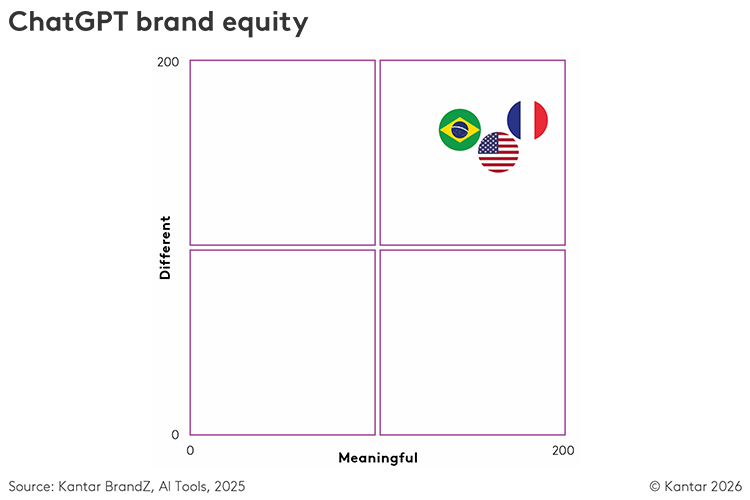
ChatGPT has a clear first-mover advantage here and already demonstrates strong consumer connections. according to Kantar BrandZ data. Its 2025 campaign sought to shift perceptions even further: from a distant tech tool to a human-centric and relatable brand. To do so, the brand shook up its look and feel. Unusually for the sector, it took its visual cues from the world of cinema. The resulting work is more emotive and evocative – a strategic move to strengthen predisposition in a market where functional parity arrives fast.
Winning hearts and minds
Functional performance is the baseline for any brand, but not the be-all and end-all. People will buy a brand because it does what they need it to do. But they will come back to it - and advocate for it - in part because it makes them feel something.
In practice, functional and emotional associations are rarely separate. They reinforce one another in a loop. For a beauty shopper, that loop might sound something like this: ‘I love how Charlotte Tilbury’s makeup lasts the whole day, because when it does, it also makes me feel more confident’. This is why brands that build strong emotional connections have better growth prospects.
Brands that truly resonate emotionally are often those aligned with cultural momentum. Consider Airbnb’s ‘Belong Anywhere’, which champions inclusion and shared experience, or Always’ #LikeAGirl campaign, which empowers young girls and challenges outdated perceptions.
Nike is renowned for its emotive campaigns. But crucially, the brand also manages to strike a chord with cultural conversation – whether that’s taking a stand with Colin Kaepernick, or elevating women in sport with Serena Williams. These campaigns aren’t just emotive words; they are attuned to real-world social discussion, amplifying topics that people really care about.
Enduring cultural resonance isn’t always driven by bold, high-profile movements. It can also emerge from simply reflecting people’s everyday lives and needs. Spotify Wrapped is a powerful example: an annual cultural ritual built from billions of listener data points. It resonates because it mirrors our identity back to us, transforming listening habits into a personalised story of the year. Designed for sharing, it also fosters social connection, creating a sense of belonging and collective participation.
Spotify’s annual Wrapped bonanza is thus a great example of a wider truth. To build cultural relevance, brands must know everything about their audience - their habits, their interests, their aspirations - and then turn those signals into strategic intelligence they can act on.

Consistency that compounds
A single, strong, culturally engaged campaign will only get you so far. What you want, ultimately, is to create a network of positive associations linked by your brand’s core identity. Consistently distinctive assets and messages act as connective tissue linking every cultural exposure (campaigns, partnerships, activations) back to existing memory structures.
Little by little, these connections increase the chances that consumers are nudged towards your brand. It’s for this reason that both Nike and Spotify have been able to build deep cultural capital: their cultural moments were not one-off flashes, but repeated expressions of what they stand for.
Clarity and consistency matter even more as agentic search reshapes the way consumers choose brands. Brands with clear, consistent, machine-readable codes will be easier for AI engines to surface, understand, and select.
These two attributes are also key to winning in today’s influencer-driven social media ecosystem. Creator voices have made it easier for brands to show up authentically for their audiences, but only sometimes, it turns out.
In 2025, 74% of brands increased their creator marketing budgets. However, Kantar Context Lab data shows that only 27% of creator content is strongly linked to the brand. This suggests a consistent failure to feature clear brand assets. Improving on this score doesn’t mean turning back toward fully centralised message control; there’s not much point of working with creators if you’re going to give them all the same rigid script to follow. But you do need to ensure that every partnership and creative moment connects back to the same core identity and brand assets.
Move beyond moments
There have never been more ways for brands to show up in culture - powered by richer signals, faster decisions, and smarter platforms. But presence alone isn’t enough.The brands that will win today and in the future aren’t chasing short-term bursts of cultural relevance. Instead, they are intentionally building cultural capital through consistency and authenticity, guided by real intelligence.
So, stop chasing short-term spikes and start measuring how you are shifting predisposition by showing up credibly, coherently and consistently in the cultural spaces that truly matter.
Discover how the most valuable brands win in Kantar BrandZ’s 2026 Most Valuable Global Brands report now available at www.kantar.com/campaigns/brandz/global